lunes, agosto 08, 2016

GMOs, Greenpeace and Nobel Laureates

http://www.counterpunch.org/2016/07/13/gmos-greenpeace-and-nobel-laureates/

By Carmelo Ruiz

Supporters of genetic modification technology, known as GMO, apparently scored a big one on June 30 with the publication of an open letter signed by over 100 Nobel prize laureates blasting Greenpeace for its opposition to GMO crops, in particular so-called ‘golden rice’, supposedly high in vitamin A. But activists and critical experts see the much publicized open letter as no more than a clumsy and awkward public relations move.


Etiquetas: , , ,

viernes, julio 01, 2016

Viva Vermont!

sábado, mayo 28, 2016

Anti-Monsanto rally in Puerto Rico 5/21/16 - Marcha contra Monsanto en Puerto Rico, 21 de mayo 2016

Fotos por Luis López


Etiquetas: , , , , , , ,

viernes, mayo 27, 2016

No, "science" has not confirmed that GMOs are safe to eat

First, and most importantly, the NAS doesn't hold an "umbrella" view on the safety of GMOs. Along with many other international bodies, it recognises that such a view is untenable, given that the GM process can give rise to different and unpredictable effects in each case. The committee points out that it has received "impassioned requests" to give the public a simple, general, authoritative answer about GM crops, but that given the complexity of GMO issues, it did not see that as appropriate. Following that, in a 400-page document, the committee develops its view on the issue. That view is undoubtedly more favourable to the use of GMOs in agriculture than that of most environmental groups – but it is also much more conservative than that of many GMO promoters (including El País). Far from stating that "science has confirmed that GMOs are safe", the report could be more accurately summarised as stating, "There’s a lot that we don’t know, which isn’t surprising, because no one is looking."

Etiquetas: , ,

jueves, marzo 24, 2016

Merge-Santo: New Threat to Food Sovereignty


A briefing by the ETC Group

As ETC first warned in May[i] last year and again in February[ii] this year, the pressure of two mergers among the Big Six Gene Giants would make a third merger inevitable. In the last few days the business media have reported that Monsanto is in separate talks with Bayer and BASF – the two German giants among agricultural input companies. While anti-competition regulators are fussing about the hook up of DuPont with Dow and of Syngenta with Chem China, Monsanto urgently needs to make a match. They hope that if regulators let the other two deals go through, they won’t be able to deny Monsanto a chance to even the score.

If the companies get their way, the first links in the industrial food chain (seeds, pesticides) will be in the hands of just three companies. If the marriages of DuPont-Dow and Syngenta–Chem China go through and Monsanto merges with Bayer’s Agricultural division, the three will control more than 65% of global pesticide sales and almost 61% of commercial seed sales. If Monsanto and BASF strike a deal instead, the Titanic Three will still have almost 61% of pesticides and more than 57% of seeds (see chart below). 

Either way, a fourth move will be inevitable. Whichever company is left at the altar (Bayer or BASF) will have to buy or sell since it won’t have the clout to take on the Three. Either could prove irresistible for Deere & Co. or one of the other huge farm machinery companies that are in the best position to ultimately dominate all on-farm related agricultural inputs from seeds and pesticides to fertilizers, machinery, data and insurance.

Etiquetas: , , , ,

domingo, marzo 20, 2016

You Wanna Know What You’re Eating? Get Ready for Lawsuits


http://www.progressive.org/news/2016/02/188581/knowing-
what-you%E2%80%99re-eating-get-ready-lawsuits

Carmelo Ruiz

The states of Vermont and California have made major strides in defending consumers’ right to know about the presence of genetically modified (GM) content in their food and the toxicity of agrochemicals. But industry wants to punish them for it. 

Etiquetas: , , , , ,

jueves, marzo 17, 2016

The spurning of Monsanto, tip of the iceberg?


http://foodfirst.org/the-spurning-of-monsanto-tip-of-the-iceberg/

By Carmelo Ruiz


The US-based agrochemical corporation, a world leader in the plant biotechnology and seed sectors, had pinned its hopes on buying Syngenta and was not counting on the Chinese government stepping in with a higher bid. It is no secret that Monsanto is having a hard time. At the end of 2015 it fired 2,600 employees and announced 1,000 more layoffs this year—16% of the company’s workforce. (2)

Since 2000, Monsanto has based its business model on an extremely simple product line, selling genetically modified (GM) seeds (mostly corn and soy) that have been engineered to tolerate their trademark Roundup herbicide. These seeds, known as Roundup Ready, sold along with the herbicide, became one of the biggest agribusiness success stories of all time. But this business model is fast becoming more of a liability than an asset. Quite predictably, weeds are developing resistance (3), and evidence of Roundup’s toxicity is becoming ever harder to discredit and deny.(4) Monsanto is trying to extricate itself from the Roundup Ready wreckage.

Etiquetas: , , , , , ,

domingo, enero 24, 2016

Monsanto is dead, long live Monsanto


http://www.gmwatch.org/2016-articles/16654-monsanto-is-dead-long-live-monsanto

By Carmelo Ruiz

EXCERPTS:

The much-detested Monsanto biotechnology corporation will likely change its name this year following its imminent merger with its European counterpart Syngenta. Such a merger would beget an unprecedented behemoth that would control 45% of the world commercial seed market and 30% of the global agrochemical sector.(1)

The US-based Monsanto, which began in 1901 as a chemical company, is currently the world’s largest seed company, with some 26% of the world market. In the 1970s Monsanto invented the systemic herbicide glyphosate. Sold by the company under the brand name Roundup, it is the most lucrative agricultural poison in history. This company dominates the world market for genetically modified (GM) seed, trouncing its competitors by a broad margin. The majority of its GM seeds have been modified to tolerate being sprayed with glyphosate, and are thus called Roundup Ready seeds. This particular use of GM technology allows Monsanto to sell the seed and the herbicide as one integrated package. 

******

Monsanto started buying big into the biotech and seed businesses in the waning years of the 20th century, conducting its first open air GM crop field tests in Puerto Rico and other locations in 1987. It then went on a binge, buying out companies like Agracetus, Asgrow, Calgene, Dekalb and Holden Seeds, and reorganizing into a “life sciences” company in 2000.(2) It became the world’s number one seed company in 2005 when it purchased Mexico’s Seminis for $1.4 billion.(3)

Syngenta, with 28,000 employees in over 90 countries, describes itself as “a leading agriculture company helping to improve global food security by enabling millions of farmers to make better use of available resources”.(4) Founded in 2000, it was the product of a merger of the agricultural businesses of Novartis and AstraZeneca. Novartis was in turn the product of a 1996 merger between Ciba Geigy and Sandoz, back then one of the largest corporate mergers in history, while AstraZeneca came into existence in a 1999 merger.(5)

Etiquetas: , , , , , , , , , ,

lunes, noviembre 30, 2015

Outsmarting nature?


http://www.etcgroup.org/content/outsmarting-nature


Many of the world's largest agro-industrial corporations are pushing forward the poorly-defined idea of "Climate-Smart Agriculture"(CSA) to re-market industrial agriculture as 'climate-ready'. This report uncovers how some advocates of CSA are embracing the extreme genetic engineering tools of synthetic biology ("Syn Bio") to develop a set of false solutions to the climate crisis.
The 20-page report includes:
-       An overview of the Players lining up behind the “Climate-Smart” brand and the Global Alliance for Climate Smart Agriculture (GACSA).
-       Details and critique of public and private research projects to alter photosynthesis pathways in plants and microbes, theoretically to increase the carbon sequestration of plants.
-      Details and critique of Synthetic Biology projects that aim to increase nitrogen fixation in plants and create ‘self-fertilizing plants,’ theoretically to reduce fertilizer applications.
-      An exposé of new Syn Bio applications developed by agrochemical giant Syngenta that make the activation of ‘climate-tolerance’ traits dependent on the application of proprietary pesticides – thereby tying farmers closer to agrochemical use.
-      Proposals to release controversial ‘Gene Drive’ technology into the wild to make weed populations more susceptible to Monsanto’s Roundup herbicide, altering ecosystems to extend the commercial viability of that agrochemical.

Etiquetas: , , ,

sábado, mayo 30, 2015

Carmelo Ruiz: Are the GMO advocates playing fair?

http://www.telesurtv.net/english/bloggers/Are-the-Pro-GM-Debaters-Playing-Fair-20150320-0001.html

How independent are the “independent” experts that advocate for GM foods? Are they being secretly paid like some climate change “skeptics”? The activist group U.S. Right To Know (USRTK), decided to find out. On February 2015 USRTK filed a FOIA request for the e-mails and correspondence of public university professors that write for GMO Answers, a pro-GM advocacy web site set up by the Ketchum public relations agency. “We taxpayers deserve to know the details about when our taxpayer-paid employees front for private corporations and their slick PR firms,” said Gary Ruskin, the organization´s executive director.

Etiquetas: , , ,

lunes, mayo 04, 2015

Scientific American, not so scientific

jueves, junio 26, 2014

Scientists comment on Seralini re-publication

http://www.biosafety-info.net/article.php?aid=1075

Dr Michael Antoniou, a molecular geneticist based in London, commented, “Few studies would survive such intensive scrutiny by fellow scientists. The republication of the study after three expert reviews is a testament to its rigour, as well as to the integrity of the researchers. 

“If anyone still doubts the quality of this study, they should simply read the republished paper. The science speaks for itself. 
“If even then they refuse to accept the results, they should launch their own research study on these two toxic products that have now been in the human food and animal feed chain for many years.” 

Dr Jack A Heinemann, Professor of Molecular Biology and Genetics, University of Canterbury, New Zealand, called the republication “an important demonstration of the resilience of the scientific community”. Dr Heinemann continued, “The first publication of these results revealed some of the viciousness that can be unleashed on researchers presenting uncomfortable findings. I applaud Environmental Sciences Europe for submitting the work to yet another round of rigorous blind peer review and then bravely standing by the process and the recommendations of its reviewers, especially after witnessing the events surrounding the first publication. 

“This study has arguably prevailed through the most comprehensive and independent review process to which any scientific study on GMOs has ever been subjected. 

“The work provides important new knowledge that must be taken into account by the community that evaluates and reports upon the risks of genetically modified organisms, indeed upon all sources of pesticide in our food and feed chains. In time these findings must be verified by repetition or challenged by superior experimentation. In my view, nothing constructive for risk assessment or promotion of GM biotechnology has been achieved by attempting to expunge these data from the public record.” 

For more info: http://bioseguridad.blogspot.com/search/label/Seralini

Etiquetas: , , , ,

sábado, mayo 10, 2014

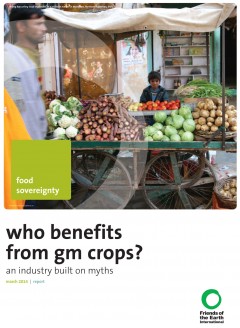
Who benefits from GMO?

http://www.foeeurope.org/who-benefits-gm-crops-industry-myths-280314

Who benefits from GM crops? An industry built on myths

28 MARCH 2014
Our relationship with food and the way in which we farm is under increasing pressure. Extreme weather events, a changing climate and a growing population are putting the food sovereignty of communities at risk. At the same time health experts have raised serious questions about our modern diet.
The way we farm and feed the world needs fundamental change. The biotech industry is claiming to offer exactly that. But this report examines the reality of GM crop production worldwide, and drawing evidence from the experiences of small farmers and the communities who live with GM, separates facts from fiction.

Etiquetas: , , ,

jueves, abril 17, 2014

Organic Consumers Association Statement on GMO Labeling Law Victory in Vermont


http://www.organicconsumers.org/articles/article_29778.cfm


  • Vermont Lawmakers Pass Country’s First No-Strings-Attached GMO Labeling Law 
    Organic Consumers Association, April 16, 2014 


For related articles and more information, please visit OCA's Millions Against Monsanto and our Genetic Engineering page.

FOR IMMEDIATE RELEASE
April 16, 2014
    
CONTACT: Organic Consumers Association, Katherine Paul, 207.653.3090

FINLAND, Minn. – Today, by a vote of 28-2, the Vermont state Senate passed H.112, a bill to require mandatory labeling of foods sold in Vermont that contain genetically modified organisms (GMOs). The bill also makes it illegal to call any food product containing GMOs “natural” or “all natural.” Unlike bills passed last year in Maine and Connecticut, which require four or five other states to pass GMO labeling laws before they can be enacted, Vermont’s law contains no “trigger” clauses, making it the first “clean” GMO labeling law in the country.

The bill now goes back to the House which is expected to agree to the Senate’s amendments, then to Gov. Peter Shumlin who is expected to sign it. 

Ronnie Cummins, national director of the Organic Consumers Association (OCA), issued the following statement:

Today’s victory in Vermont has been 20 years in the making. Ever since genetically modified crops and foods entered the U.S. food supply in the early 1990s, without adequate independent pre-market safety testing and without labels, U.S. consumers have fought to require the labeling of foods containing GMOs.

Consumer demand for mandatory labeling of GMOs spawned a national grassroots movement that has persevered despite hundreds of millions of dollars spent by the biotech and food industries to lobby state lawmakers in Vermont, and to fund anti-labeling campaigns in California (2012) and Washington State (2013).

Today, consumers and a number of principled legislators in Vermont made it clear to Monsanto, Coca-Cola and other opponents of consumers’ right to know: We will not back down. This movement is here to stay.

We expect that Monsanto will sue the state of Vermont in order to prevent enactment of H.112. We also expect that Monsanto will lose, and the law will go into effect on schedule, on July 1, 2016.

We expect that the Grocery Manufacturers Association, a multi-billion lobbying group representing more than 300 food, pesticide and drug makers, will try to pass their “Safe and Accurate Food Labeling Act of 2014,” introduced last week by Rep. Mike Pompeo (R-Kan.), intended to strip Vermont, and all other states, of their right to pass GMO labeling laws. And we expect that Congress will not pass this law, dubbed the DARK (Deny Americans the Right to Know) Act, which seeks to deny consumers the right to know if their food has been genetically engineered, and deny states the right to enact laws designed to protect public health.

Vermont’s landmark victory today will force food companies to either label GMOs in all states, or reformulate their products to be GMO-free in order to avoid stating “this product was produced using genetic engineering” on their packaging. When Oregon passes a citizens’ ballot initiative to label GMOs in November, as we believe it will, the biotech and food industries will have lost, beyond the shadow of a doubt, their battle to keep consumers in the dark.

The OCA has worked closely over the past several years with the pro-labeling grassroots movement in Vermont. Today we congratulate Vermont activists for their passionate pursuit of this law, Vermont lawmakers for having the courage to pass the law, and Vermont citizens for being the first in the country to have the benefit of GMO labels on their food. And we reaffirm our commitment to work with Oregon and other states to pass similar laws, and to fight any and all attempts by industry and/or Congress to overturn these laws.

For press inquiries, please contact Katherine Paul by email or phone: 207.653.3090

The Organic Consumers Association (OCA) is an online and grassroots non-profit 501(c)3 public interest organization campaigning for health, justice, and sustainability. The Organic Consumers Fund is a 501(c)4 allied organization of the Organic Consumers Association, focused on grassroots lobbying and legislative action.

Etiquetas: , , , , ,

miércoles, abril 09, 2014

Letter from a Scientist to the President of Mexico

http://ejfood.blogspot.com/2014/04/geo-watch-exclusive-letter-from.html


Moderator’s Note: Our colleague Miguel Robles of theBiosafety Alliance provided access to a unique set of documents recently released and formerly submitted to the President of Mexico by various scientists. The letters all warn of the environmental and public health dangers posed by transgenic or GMO maize. I am posting the first of these documents: Our exclusive translation of a letter released over the weekend by our colleagues at Acción Colectiva in Mexico. The 8-page (plus references) letter was prepared by Dr. David Schubert, considered one of the foremost immunologists at the Salk Institute. It is addressed to Lic. Enrique Peña Nieto
, President of Mexico, and the heads of the Mexican Environmental Protection and Agriculture ministries. The letter was submitted last October 2013 as part of the evidence presented at trial before the federal judge that ruled to suspend GMO corn plantings in Mexico.

Schubert’s letter mentions six major problems posed by the cultivation and consumption of transgenic corn in Mexico but focuses special attention on the human public health implications. There are quite a few novel ideas here for many of my readers and followers, not the least of which is Schubert’s justified concern over the lack of epidemiological data, the lack of which should lead to the precautionary principle.

However, Schubert raises some interesting questions, especially about the normalization of the US diet as a stand-in for the Mexican diet and the implications this has for the careless use of fancy food safety algorithms to argue that GMO corn is safe, because it is presumably safe in the US. Schubert makes the insightful and profound observation that:

(1) Corn is not a staple crop in the American diet the way it is in the Mexican diet; (2) This means that Americans only indirectly eat GMO corn in forms where the risks posed by Bt proteins are largely eliminated (e.g., vegetable oils, high fructose corn syrup, etc.); and (3) The may ways Mexican cultures eat and prepare corn could result in health consequences due to unanticipated immunological and allergenic responses to such direct consumption of Bt proteins.

Schubert concludes with a foreboding prognosis: “…perhaps the greatest concern about the introduction of any GM product on the market should be that, even when it causes harm to human health, it would be impossible to detect due to the lack of epidemiological studies and technical limitations.” Moreover, he continues by noting that “if the introduction of Bt corn is approved…there will…[an unparalleled] number of people who will consume Bt toxin at levels many thousands of times higher than ever before in the short history of GM technology.” Monsanto and Mexico’s neoliberal rulers want to run the largest biological experiment in human history without the informed consent of the Mexican people. This could turn to blows since the Gene Giants seem determined to move ahead with full-scale unauthorized biological experimentation on the Mexican people and the planet’s fullest complement of native maize biodiversity. These are just a few of more sobering insights offered by Dr. Schubert in his letter to Mexican President Peña Nieto.

Please note use of brackets [ ] to denote moderator edits and inserts; emphases added.


Salk Institute scientist reveals why he opposes GMOs
IN DRAMATIC LETTER TO MEXICO’S PRESIDENT

Lic. Enrique Peña Nieto

Presidente de la República Mexicana

Palacio Nacional Edif. 10 P.B.
Col. Centro, Del. Cuauhtémoc, C.P. 06067 México, D.F. enrique.penanieto@presidencia.gob.mx

Lic. Enrique Martínez y Martínez
Secretario de Agricultura, Ganadería, Desarrollo Rural, Pesca y Alimentación
 Avenida Municipio Libre 377
Col. Santa Cruz Atoyac, Del. Benito Juárez, C.P. 03310 México, D.F.

Ing. Juan José Guerra Abud

Secretario de Medio Ambiente y Recursos Naturales

Blvd. Adolfo Ruiz Cortines 4209
Col. Jardines en la Montaña, Del. Tlalpan, C.P. 14210 México, D.F.

My name is David Schubert. I have a doctorate in immunology and serve as a Professor at the Salk Institute for Biological Studies in San Diego, California, considered one of the top medical research institutions in the world. As a member of this institution I actively work on the development of drugs to treat Alzheimer’s and stroke. Therefore, I possess first-hand knowledge of molecular genetics, toxicology and safety testing involving new chemical and biological entities. I am also knowledgeable about the technology of genetically modified organisms (GMOs ) and have published articles in leading scientific journals on GM plants and their effect on human health.

TO READ THE FULL LETTER:
http://ejfood.blogspot.com/2014/04/geo-watch-exclusive-letter-from.html

Etiquetas: , , , , ,

sábado, abril 05, 2014

GMO no good

Compositional differences in soybeans on the market: glyphosate accumulates in Roundup Ready GM soybeans

http://www.biosafety-info.net/article.php?aid=1053

Bøhn, T.1,2, Cuhra, M.1,2, Traavik, T.1,2, Sanden, M.3, Fagan, J.4 and Primicerio, R.2  
1 GenØk, Centre for Biosafety, P.O. Box 6418, 9294 Tromsø, Norway
2 Faculty of Health Sciences, University of Tromsø, 9019 Tromsø, Norway
3 National Institute of Nutrition and Seafood Research, NIFES, P.O. Box 2029, 5817 Bergen, Norway
4 Earth Open Source, 2nd Floor 145-157, St. John Street, London EC1V 4PY, United Kingdom  
Corresponding author: Thomas Bøhn, GenØk, Centre for Biosafety, P.O. Box 6418, 9294 Tromsø, Norway. Email: thomas.bohn@genok.no. Phone: +4777644541  

ABSTRACT  
This article describes the nutrient and elemental composition, including residues of 21 herbicides and pesticides, of 31 soybean batches from Iowa, USA. The soy samples were grouped into three different categories: i) genetically modified, glyphosate-tolerant soy (GM-soy); ii) unmodified soy cultivated using a conventional “chemical” cultivation regime; and iii) unmodified soy cultivated using an organic cultivation regime. Organic soybeans showed the healthiest nutritional profile with more sugars, such as glucose, fructose, sucrose and maltose, significantly more total protein, zinc and less fibre than both conventional and GM-soy. Organic soybeans also contained less total saturated fat and total omega-6 fatty acids than both conventional and GM-soy. GM-soy contained high residues of glyphosate and AMPA (mean 3.3 and 5.7 mg/kg, respectively). Conventional and organic soybean batches contained none of these agrochemicals. Using 35 different nutritional and elemental variables to characterise each soy sample, we were able to discriminate GM, conventional and organic soybeans without exception, demonstrating “substantial non-equivalence” in compositional characteristics for ‘ready-to-market’ soybeans.  


High residues of glyphosate accumulate in Roundup Ready soybeans

http://www.biosafety-info.net/article.php?aid=1053

Publication date: March 21, 2014  

THIRD WORLD NETWORK BIOSAFETY INFORMATION SERVICE  

 Dear friends and colleagues, 

Research published in the peer-reviewed journal Food Chemistry has found residues of glyphosate (and its breakdown product AMPA) in high concentrations in GM soybeans, but not in conventional or organic soybeans. The study examined 31 samples of soybeans grown within a defined area within the state of Iowa, USA.  

GM soy engineered to be glyphosate resistant is the number one GM crop plant. The herbicide glyphosate is the most widely used herbicide globally. For herbicide-resistant GM plants, herbicide co-technology is an integral part of the production system and will always be used by the farmer.  

However, little attention has been given to the residues of herbicides and their metabolites that can potentially accumulate in the final product. Chemical residues, if present, are important because they are clearly a part of a plant’s composition, and they may add toxic properties to the final plant product either by itself or by affecting the plant metabolism. (There has been increasing research demonstrating the potential health impacts of glyphosate.) 

The authors suggest that the increased use of glyphosate on Roundup Ready soybeans in the US, which has contributed to the selection of glyphosate-tolerant weeds, and resulted in a response of increased doses and/or more applications used per season, may explain the plant tissue accumulation of glyphosate.  

Lack of data on pesticide residues in major crop plants is a serious gap of knowledge with potential consequences for human and animal health. The authors therefore recommend the following:

(i)                 increased effort on sampling and testing crop material from the market;

(ii)   testing for possible dose-response effects of chemical residues in long-term feeding studies;

(iii)  inclusion of pesticide residue measurements and safety testing in the regulatory system for risk assessment of GM crops; and

(iv)  further research on the indirect ecological effects of herbicides and pesticides.  

The study also showed that different agricultural practices may result in a markedly different nutritional composition of soybeans, with organic soybeans having the healthiest nutritional profile compared to GM and conventional soybeans.  

In sum, the data demonstrated that different agricultural practices lead to markedly different end products, i.e. there is no substantial equivalence between the three management systems of herbicide resistant GM, conventional and organic agriculture.  

Etiquetas: , , , ,

miércoles, marzo 12, 2014

Label GMOs? Or Ban Them?

ESSAY OF THE WEEK

Label GMOs? Or Ban Them?

The introduction in the mid-nineties of genetically engineered crops into the U.S. food supply—with no independent safety-testing or labeling required—sparked a debate over how to drive these unhealthy andenvironmentally destructive “Frankenfoods” off the market.

Some campaigners have called for an outright ban of GE crops. Others argue that strict mandatory labeling laws, similar to those in the EU, are all we need in order to rid the world of GMOs (Genetically Modified Organisms).

Who’s right?

A review of two decades of anti-GMO campaigning in North America and Europe suggests that mandatory labeling and bans, or GMO-free zones, should go hand-in-hand. And recent news about increased contamination of non-GMO crops by the growing number of USDA-approved GMO crops suggests that if we don’t implement labeling laws and bans sooner rather than later, we may run out of time to protect organic and non-GMO farmers and their fields.
Read Ronnie’s essay
Support GMO bans and labeling laws


ORGANIC RETAIL & CONSUMER ALLIANCE

Help Your Grocer Go GMO-Free

In the spring of 2013, OCA asked consumers to nominate grocers who are doing a great job of protecting their customers’ health by saying no to GMOs (genetically modified organisms). From those nominations, we chose 12 overall winners of our Right to Know Grocers Contest. We call them the “Diligent Dozen.”

The contest proved to be a great way to single out grocers across the country who are doing a heroic job of educating customers about GMOs, providing truthful labels on products containing GMOs, and working with manufacturers to get GMOs out of popular consumer products, including food, supplements and cosmetics.

But the Right to Know Grocers Contest also proved to be a learning experience for us. From our interviews with more than 50 store staff, owners and managers, we learned what motivates them to educate consumers and provide non-GMO alternatives. We also learned about the challenges they face, and the strategies they’ve developed, in their quest to rid their shelves of foods containing GMOs.

We took that information and created the Going GMO-Free Toolkit for Grocers. It includes:

• Strategies for educating consumers
• Sample GMO-free policy statements
• Sample communications to manufacturers
• Instructions for conducting a GMO audit
• Insights into the challenges of finding non-GMO alternatives
• Success stories

Want to help your local grocer go GMO-Free? Share the toolkit with the store owner or manager, and let us know how your favorite retailer responds! 

Download this Leaflet and Show it to Your Grocer

Read the Going GMO-Free Toolkit for Grocers
 

Etiquetas: , , ,

lunes, marzo 03, 2014

Monsanto's ‘Science’ Doesn’t Add Up

ESSAY OF THE WEEK

Five New Reasons Monsanto’s ‘Science’ Doesn’t Add Up

To hear the pesticide and junk food marketers of the world tell it, anyone who questions the value, legitimacy or safety of GMO crops is naïve, anti-science and irrational to the point of hysteria. But how long can Monsanto ignore the mounting actualscientific evidence that their technology is not only failing to live up to its promises, it's putting public health at risk?
Jim Goodman, farmer, activist and member of the Organic Consumers Association policy advisory board, recently wrote about Monsanto's deceptive use of the expression "sound science." But, 'sound science' has no scientific definition. It does not mean peer reviewed, or well documented research.
'Sound science' is only a term, an ideological term, used to support a particular point of view, policy statement or a technology. 'Sound science' is little more than the opinions of so-called "experts" representing corporate interests. Simply put, 'sound science' always supports the position of industry over people, corporate profit over food safety, the environment and public health.
Here are five new reports and studies, published in the last two months, that blow huge holes in Monsanto's "sound science" story. Reports of everything from Monsanto's Roundup causing fatal, chronic kidney disease to how, contrary to industry claims, Roundup persists for years, contaminating soil, air and water. And oh-by-the-way, no, GMO crops will not feed the world, nor have they reduced the use of herbicides and pesticides. 

Read the essay

Etiquetas: , , , ,

jueves, febrero 13, 2014

They are comparing us to Al Qaeda, seriously!

By Carmelo Ruiz-Marrero
Puerto Rico Project on Biosafety
February 6 2014

Industry consultant and outspoken GMO advocate Paul Christensen has spent a lot of his time and energy studying "our movement" for his clients. Just going over his blog postings I found this item from last September, which suggests this guy has really gone off the deep end: http://www.intlcorn.com/seedsiteblog/?p=1723


The Origins of Al-Qaeda and the Evolution of Opposition to GMOs and the Seed Industry


And now for some delicious excerpts:

I began this article on the assumption that there were similarities worth mentioning between al-Qaeda and the anti-globalization and food movements.  Both think that another postmodern world is possible.  In the case of al-Queda it is an Islamic fundamentalist world that is to come after the modern period and reconstitute the pre-modern Islamic world.  In the case of anti-globalization and food movements the new world would be regional, directly democratic, organic and environmentally conscious, nonviolent and have a kind of social justice in which markets would be socially managed.

In some sense the two organizations are competing over some of the same intellectual ground. 
******
Although both al-Qaeda and the anti-globalization and food movements reject modernity, they do so in ways that are quite different. 
******
The anti-globalization and food movements sometimes have charismatic leaders and frequently have beliefs which are not objective and so strongly held that they seem as though they are religious. 
******
Both al-Qaeda and the anti-globalization and food movements are inclined to symbolic action. 
******
The village level government ideal of low technology and grass roots democracy supported by the anti-globalization and food movements leaves societies vulnerable to authoritarians like bin Laden, if they can muster enough charisma to propose an ideal which will capture imaginations for a while.
******
Mohandas Gandhi, Osama bin Laden, José Bové, Mohammad Morsi, Subcomdant Marcos, Adolf Hitler and Michael Pollan make strange bedfellows, but they all share a fundamental and unshakable rejection of the usual kind of liberalism. 
End of quotes


Is Christensen a great guy to have a beer with or what? But on a serious note, how can there be a reasoned dialogue and debate with those who lump us together with Osama Bin Laden and liken us to the zombies in World War Z?

Etiquetas: , , ,