sábado, abril 07, 2012

Alperovitz- America Beyond Capitalism

http://will.illinois.edu/mediamatters/

Gar Alperovitz dicusses America Beyond Capitalism.
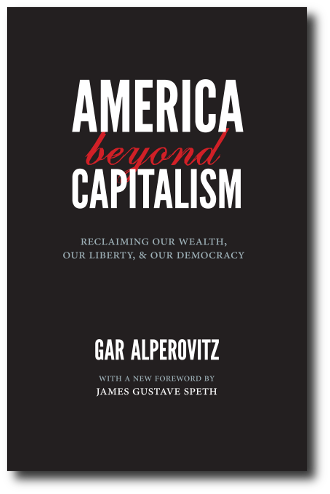
As discontent with the economic and political status quo mounts in the wake of the “great recession”, America Beyond Capitalism is a book whose time has come. Gar Alperovitz’s expert diagnosis of the long-term structural crisis of the American economic and political system is accompanied by detailed, practical answers to the problems we face as a society. Unlike many books that reserve a few pages of a concluding chapter to offer generalized, tentative solutions, Alperovitz marshals years of research into emerging “new economy” strategies to present a comprehensive picture of practical bottom-up efforts currently underway in thousands of communities across the United States. All democratize wealth and empower communities, not corporations: worker-ownership, cooperatives, community land trusts, social enterprises, along with many supporting municipal, state and longer term federal strategies as well. America Beyond Capitalism is a call to arms, an eminently practical roadmap for laying foundations to change a faltering system that increasingly fails to sustain the great American values of equality, liberty and meaningful democracy.

Gar Alperovitz has had a distinguished career as a historian, political economist, activist and government official. He is currently the Lionel R. Bauman Professor of Political Economy at the University of Maryland. He grew up in America’s heartland in Racine, Wisconsin, in the 1940s, and received a bachelor of science degree from the University of Wisconsin; a masters degree from the University of California at Berkeley; and his Ph.D. in political economy as a Marshall Scholar at Cambridge University. After completing his studies he served as a legislative director in both houses of Congress and as a special assistant in the State Department. Among his many achievements is having been the architect of the first modern steel industry attempt at worker ownership in Youngstown, Ohio. In addition to America Beyond Capitalism, he has authored Unjust Deserts: How the Rich Are Taking Our Common Inheritance, and The Decision To Use the Atomic Bomb, and his articles have appeared in the New York Times, Washington Post, Los Angeles Times and The Nation. He is a founding principal of the University of Maryland-based Democracy Collaborative, a research institution developing practical, policy-focused, and systematic paths towards ecologically sustainable, community-oriented change and the democratization of wealth.

Audio archives:

Play now:

Download: mp3 file

Show links:

Etiquetas: , , , ,

miércoles, noviembre 02, 2011

How One Percent Grabbed So Much of Our Wealth
The economic benefits of knowledge-- which belong to us all-- flow to the rich

By Gar Alperovitz


Gar Alperovitz, professor of Political Economy at the University of Maryland, details how the rich have commandeered the commons for their own benefit in his book Unjust Deserts: How the Rich Are Taking Our Common Inheritance and Why We Should Take It Back (with Lew Daley from The New Press). See the excerpt from On the Commons. Here in an essay from Truth Out he shows how the commons of knowledge— a human inheritance which is rightly shared by all—has become the foundation for the 1 percent’s lavish wealth. — Jay Walljasper

Elizabeth Warren points out that there “is nobody in this country who got rich on his own. Nobody.” Meaning: if the rich don’t pay their fair share of the taxes that educate their workers and provide roads, security and many other things, they are essentially stealing from everyone else.

The biggest “theft” by the 1 percent has been of the primary source of wealth—knowledge—for its own benefit.

Knowledge? Yes, of course, and increasingly so. The fact is, most of what we call wealth is now known to be overwhelmingly the product of technical, scientific and other knowledge—and most of this innovation derives from socially inherited knowledge. Which means that, except for trivial amounts, it was simply not created by the 1 percent who enjoy the lion’s share of its benefits. Most of it was created, historically, by society—which is to say, the other 99 percent.

Take an obvious example: Many of the advances that have propelled our high-tech economy in recent decades grew directly out of research programs financed and, often, collaboratively developed, by the federal government and paid for by the taxpayer. The Internet, to take the most well-known example, began as a government defense project, the Advanced Research Projects Agency Network (ARPANET), in the 1960s. Today’s vast software industry rests on a foundation of computer language and operating hardware developed, in large part, with public support. The Bill Gateses of the world might still be working with vacuum tubes and punch cards were it not for critical research and technology programs created or financed by the federal government.

The iPhone is another example: Its microchips, cellular communication abilities and global positioning system (GPS) all flowed from developments traceable to significant direct and indirect public support from the military and space programs. The “revolutionary” multi-touch screen was developed by University of Delaware researchers financially supported by the National Science Foundation and the CIA. It is not only electronics: of the 15 modern US-developed “blockbuster” drugs with over $1 billion in sales, 13 received significant public research and development support.

TO READ THE REST:
http://www.onthecommons.org/how-one-percent-grabbed-so-much-our-wealth

Etiquetas: , , ,

domingo, marzo 01, 2009

The Rich Are Hogging Our Common Inheritance

And how we can take it back.


_The following is an excerpt from Unjust Deserts: How the Rich Are Taking Our Common Inheritance and Why We Should Take It Back

by Gar Alperovitz and Lew Daly, published by the New Press, 2008.

Technological progress … has provided society with what economists call a “free lunch,” that is, an increase in output that is not commensurate with the increase in effort and cost necessary to bring it about. — Joel Mokyr, Lever of Riches: Technological Creativity and Economic Progress (1990)

Warren Buffett, one of the wealthiest men in the nation, is worth over $60 billion. Does he “deserve” all this money? Why? Did he work so much harder than everyone else? Did he create something so extraordinary that no one else could have created? Ask Buffett himself and he will tell you that personally he thinks that “society is responsible for a very significant percentage of what I’ve earned.”

But if this is true, doesn’t society deserve a very significant share of what he has received?

Buffett may not know it, but he has put his finger on one of the most explosive issues developing just beneath the surface of public awareness. In recent decades researchers working in a broad range of economic, technological, and other fields have clarified much more precisely than in the past the many ways “society” contributes to the creation of “wealth” — and, accordingly, how relatively little any one individual can be said to have earned and “deserved.” Their research, in turn, raises profound moral — and ultimately political — questions that are becoming increasingly difficult to avoid. At the heart of this revolution in understanding is a fundamental reconsideration of the extraordinary role of knowledge in economic growth — and of how ever-increasing knowledge, accumulating across the generations, is central to the creation of all wealth.


SOURCE: http://www.onthecommons.org/content.php?id=2331

Etiquetas: ,