jueves, noviembre 06, 2014

BRAZIL: TORTURE TECHNIQUES REVEALED IN DECLASSIFIED U.S. DOCUMENTS

http://www2.gwu.edu/~nsarchiv/NSAEBB/NSAEBB478/
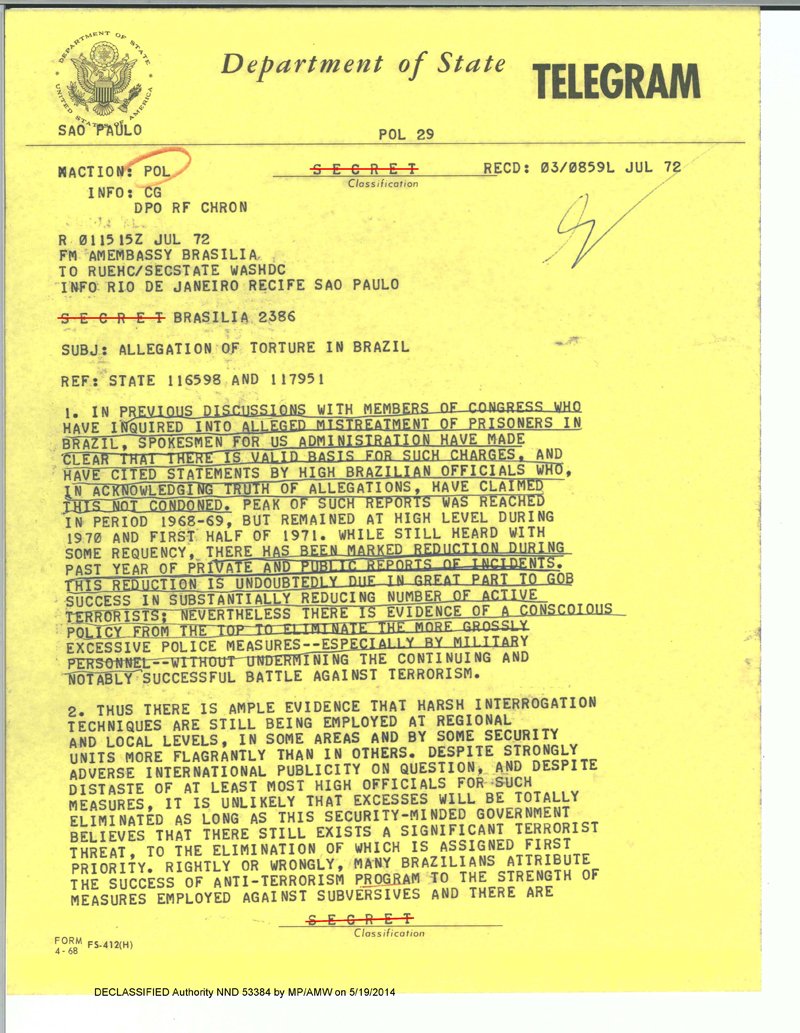

"Allegations of Torture in Brazil."

DICTATORSHIP-ERA RECORDS GIVEN BY VICE PRESIDENT BIDEN TO PRESIDENT ROUSSEFF

DETAIL "PSYCHOPHYSICAL" SYSTEMS OF TORTURE, SECRET EXECUTIONS

43 STATE DEPARTMENT RECORDS MADE PUBLIC BY BRAZILIAN TRUTH COMMISSION


Peter Kornbluh who directs the National Security Archive's Brazil Documentation Project called the document "one of the most detailed reports on torture techniques ever declassified by the U.S. government."

Titled "Widespread Arrests and Psychophysical Interrogation of Suspected Subversives," the document was among 43 State Department cables and reports that Vice President Joseph Biden turned over on June 17 to President Dilma Rousseff during his trip to Brazil for the World Cup competition for use by the Brazilian Truth Commission. The Commission is in the final phase of a two-year investigation of human rights atrocities during the military dictatorship which lasted from 1964 to 1985. On July 2, the Commission posted all 43 documents on its website...

The records range in date from 1967 to 1977. They report on a wide range of human rights-related issues, among them: secret torture detention centers in Sao Paulo, the military's counter-subversion operations, attitudes of the Church on human rights violations, and the regime's hostile reaction in 1977 to the first State Department human rights report on abuses. Some of the documents had been previously declassified under routine release procedures; others, including the April 1973 report on psychophysical torture, were reviewed for declassification as recently as June 5, 2014, in preparation for Biden's trip.

Etiquetas: , ,

sábado, octubre 11, 2014

CIA gives in to FOIA request, but that's not the weird part

http://nsarchive.wordpress.com/2014/09/22/the-foia-request-that-cost-agency-employee-
jeffrey-scudder-his-job-finally-results-in-cia-posting-trove-of-studies-in-intelligence-articles/

The FOIA Request that Cost Agency Employee Jeffrey Scudder His Job Finally Results in CIA Posting Trove of Studies in Intelligence Articles

SEPTEMBER 22, 2014
EXCERPT:

Scudder, then a project manager for the CIA’s Historical Collections Division, filed a FOIA request in 2o07 for 419 Studies in Intelligence articles after discovering “a stack of articles, hundreds of histories of long-dormant conflicts and operations that he concluded were still being stored in secret years after they should have been shared with the public.” During the process of filing the request, Scudder was“confronted by supervisors and accused of mishandling classified information while assembling his FOIA request. His house was raided by the FBI and his family’s computers seized. Stripped of his job and his security clearance, Scudder said he agreed to retire last year after being told that if he refused, he risked losing much of his pension.”
Despite the agency’s harassment, Scudder carried on with his FOIA request, inevitably filing a FOIA lawsuit for the documents’ release. As part of his initial request, Scudder asked that the documents be released in electronic format – the form that they were already in. The CIA, however, continued its common practice of refusing to release soft copies of its records – ostensibly for security reasons – and told Scudder he could only have hard copies of the articles, which would cost Scudder twice as much. Scudder sued the agency, contending that the CIA was frustrating his efforts to obtain the documents –and charging him double for doing so. District Court judge Beryl Howell agreed with Scudder, writing that “Where, as here, an agency asserts nearly twenty years after the passage of the E-FOIA Amendments that it cannot provide any electronic formats because of a lengthy process the agency has created, a court is required by the FOIA to evaluate that process to determine if it meets the statutorily mandated ‘reasonable efforts’ standard…[a] FOIA request for records in an existing format should not be frustrated due to the agency’s decision to adopt a production process that nonetheless renders release in that format highly burdensome.”

Etiquetas: , ,