lunes, agosto 22, 2016

miércoles, mayo 04, 2016
Vieques, 16 years ago today

On a day like today 16 years ago, hundreds of peace protesters were arrested by the US government in the firing range in the island municipality of Vieques, Puerto Rico. That day I was in Marshfield, Vermont, staying at the house of my friends Judy and Jay. I was there with my compatriots Abei and Raul Noriega and Carmen Valencia touring New England to gather support for the anti-Navy struggle in Vieques. In the couple of days we spent there, we took our case to colleges like Burlington, Goddard and Dartmouth, churches in Montpelier and St Johnsbury, the media (WGDR radio and public access cable), the Vermont state legislature, and even had the chance to personally lobby congressman Bernie Sanders.
One of my gladdest memories of that trip was my visit to the revered and venerated peace activist Dave Dellinger's house for a meeting of the local Vieques solidarity committee.
On this historic anniversary, so important for the history of Puerto Rico and of the worldwide peace movement, I share with you this compilation of Vieques-related links and info resources which includes some articles of mine:
Etiquetas: Carmelo, Dave Dellinger, eng, Puerto Rico, Vermont, Vieques
A Vieques op-ed I wrote in early 2000
NOT ONE MORE BOMB IN VIEQUES: A MESSAGE TO THE AMERICAN PEOPLE
>
> Carmelo Ruiz-Marrero
>
> Millions of Americans learned in the first week of May (2000)
> that there is an island in the Caribbean Sea named
> Vieques, and that it is the site of a peaceful,
> nonviolent struggle against the most powerful military
> apparatus in the world.
>
> On May 4th, hundreds of U.S. marshals, FBI agents and
> Puerto Rican riot police came to this idyllic
> island-town of Puerto Rico to remove hundreds of
> protesters that were camping in lands that the U.S.
> Navy uses as a firing range.
>
> The Navy occupied 26,000 of Vieques's 33,000 acres in
> 1941, and has since then used those lands not only for
> target practice, but also for naval maneuvers,
> amphibian landings, munitions storage and toxic waste
> disposal.
>
> In April of last year a stray bomb killed a civilian
> security guard working in the firing range. That was
> the last straw for the residents of Vieques and for
> concerned citizens from all over Puerto Rico. For more
> than a year, protesters, which included members of
> religious, student and peace organizations, camped in
> the range in order to serve as a human shield to
> prevent the bombing from resuming.
>
> Civil disobedience? Who's really being disobedient
> here? The Puerto Rico Bar Association determined that
> the United States government is violating its own laws
> in Vieques, including the Endangered Species Act, the
> Clean Air Act, the Clean Water Act, the National
> Environmental Policy Act and the much-celebrated
> Executive Order on Environmental Justice, signed by
> president Clinton himself; as well as international
> commitments, like the United Nations Charter, the
> Universal Declaration of Human Rights, and the 1992
> Rio Declaration.
>
> Defenders of the Navy are quick to claim that the only
> obstacle to solving the Vieques crisis is the
> protesters, who are allegedly seeking a confrontation
> that will worsen the U.S.'s relations with Puerto
> Rico. They point out that Clinton proposed a
> referendum in which the island-town's residents will
> decide whether or not they want the Navy to stay.
>
> Let's take a closer look at this referendum. Vieques
> residents will have to choose between two options: the
> Navy stays or goes. But if they vote for the Navy's
> departure, it will stay for three more years,
> practicing with inert non-explosive ammunition for 90
> days a year. Plus the Navy gets to determine the
> parameters of the referendum, even its date.
>
> The people of Puerto Rico do not want the Navy to stay
> three more years or even three more hours in Vieques.
> They want its immediate and permanent withdrawal.
> Nothing else will do.
>
> signed a memorandum of understanding with the
> government of Puerto Rico in which it committed itself
> to help protect Vieques's environment and help with
> its economic development. Last year the Navy admitted
> that it had not honored the promises it had made in
> the memorandum. In any case, how many treaties with
> Native Americans has the U.S. government honored?
>
> What if this time the Navy breaks its word "by
> mistake"? It admitted last year that it had tested
> depleted uranium ammunition in Vieques, but claimed
> hat it had done so by mistake. The death of that
> security guard last year was also a mistake. The
> bombing of the Chinese embassy in Belgrade was also a
> mistake. And the downing of an Iranian civilian
> airliner in broad daylight on international airspace
> over the Persian Gulf in 1988 was also a mistake. How
> many more mistakes or "mistakes" will have to happen
> before the U.S. government understands that its
> military is not wanted in Vieques, not for one more
> day?
>
> And why is the military supervising this referendum?
> In a democracy, the military is supposed to stay
> awayfrom politics, especially electoral politics.
> Would Americans tolerate the Pentagon intervening in
> elections?
>
> Why are Vieques residents the only ones allowed to
> vote in this referendum? Isn't this a matter of
> concern to all Puerto Ricans? Imagine if a foreign
> power were to occupy Oregon and Americans in the other
> 49 states were told to butt out and mind their own
> business. Americans shouldn't have to tolerate
> something like that for a second.
>
> If an injustice were to take place in Alabama, for
> example, it would be a matter of concern to all
> Americans, not just to those living in that state.
> Therefore, all Puerto Ricans should be able to vote on
> the future of Vieques.
>
> Why a vote at all? Did the Navy hold elections to
> occupy Vieques? Did it even ask for permission when it
> evicted thousands of its residents in the 1940's? Did
> the U.S. hold elections when it invaded Puerto Rico
> and its warships bombed San Juan in 1898?
>
> The Clinton directive on Vieques has been described in
> the media as a deal that the President made with
> Puerto Rico governor Pedro Rosselló. It is not a deal.
> It is an order of the President of the United States
> to the governor of a colony with no voice or vote in
> Washington.
>
> There are some who call the protesters anti-American.
> But the opponents of the Navy presence in Vieques are
> no more anti-American than the 19th century
> abolitionists or the 20th century civil rights
> movement.
>
> Americans living in the fifty states must make it
> clear to president Clinton that he must do the right
> thing as Commander in Chief of the Armed Forces and
> order the Navy to end its training activities in
> Vieques immediately and permanently, and clean up the
> toxic mess it made there. If the Navy doesn't like it,
> that's just too bad. In a democratic republic, the
> civilians are in charge, not the military. At least
> that's what we were all taught in school.
>
martes, abril 19, 2016
Devon Peña comments on my Vieques article
http://ejfood.blogspot.com/2014/06/environmental-justice-gardening-bombed.html
Devon Peña’s note: Speaking of the American Empire, the prison complex at Guantanamo Bay on occupied Cuban soil is not the only case of an unwanted and damaging U.S. military presence in Latin America and the Caribbean. The U.S. naval bombing range at Vieques in Puero Rico is often overlooked. From 1999 to 2003, it remained at the heart of one of the preeminent anti-militarism struggles by environmental justice activists in the Western Hemisphere.
I first became aware of the struggle against the bombing range at Vieques through the work of Professor Deborah Berman Santana, a renowned environmental justice scholar, who penned an influential paper on environmental justice at Vieques in the journal, Social Justice (2002). In that paper, Santana makes the case that military installations and activities are among the worst sources of pollution. Deborah’s work presciently connected connected militarism to environmental racism and eloquently documented the long campaign to evict the Navy and reclaim the island for the people of Puerto Rico.
So, how is Vieques today, some 15 years after the bombing ended and the Navy went home? It is too easy to forget such a place, even one that captured our imagination and thirst for justice, once the struggle has ended and life has moved on.
It is a pleasure to present this portrait of Vieques as it is today from the vantage point of Carmelo Ruíz-Marrero. There is growing crime and the looming threat of gentrification but Carmelo also found close-knit people working hard to restore the land and re-establish its role in maintaining a healthy community. The new island is a work-in-progress – and at its heart, local people are working to produce a sustainable heritage landscape that includes conventional growers and more innovative organic farmers. As I understand it, some of the island’s beekeepers arelearning how to produce honey from Africanized bees.
If you can get rid of the Navy’s bombers, you can certainly handle some angry bees while learning to make peace with the local landscape. The island is a crossroads of economic deprivation and creativity, as is so often the case when marginality is an inventive force.
There is another part to this story and not all is happy local food times for all! While the people are creatively obtaining right livelihoods on the island they are also trying to produce food and other materials on a landscape that still has very serious pollution problems from the decades of environmental abuse by the American military. As Carmelo notes:
Vieques was mercilessly bombed for sixty years from both sea and air. And the explosions lifted up deadly clouds of dust polluted with heavy metals and toxic chemicals used in ordnance and even particulate from uranium ammunition. These clouds of death moved downwind to the west, blanketing the civilian zone. The cancer rate among Vieques residents is 26.9% above Puerto Rico’s average…
So, the Navy may be long gone but it left a toxic legacy behind; one that is still affecting the health and wellbeing of the people of Vieques.
This essay originally appeared in Counterpunch Magazine, Vol. 21, No. 4. May 2014.
 |
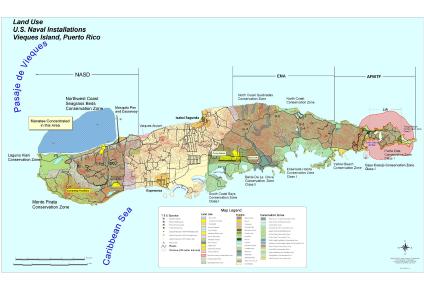
Map of Vieques used by EPA to manage Superfund sites.
|
Return to Vieques
ORGANIC GARDENS AMIDST TOXIC LEGACY?
Carmelo Ruíz-Marrero | Vieques, P.R. | January 2014
The ferry from the town of Fajardo to Vieques island leaves at 4:30 pm. I arrive at 4:25 and there is a line at the ticket counter, made up of Viequenses
Etiquetas: Carmelo, Devon Peña, eng, Vieques
domingo, marzo 20, 2016
My article about Vieques gentrification, published back in 2003

The Second Invasion of Vieques
By Carmelo Ruiz Marrero
August 30 2003
The boom of bombs has been replaced by the real estate “boom.” With the official closure of the firing range, Vieques is now the target of a runaway race of speculators, businessmen and dealers in real estate who are fishing in muddy waters.
The people of Vieques already know this phenomenon. Residents from the United States and other countries and Puerto Ricans from the big island have been for years the owners of most of the businesses on the island, especially those related to tourism, and so they gain the most from economic activities in the island-town.
The arrival of wealthy residents and businesspeople in an area that they find attractive inflates the prices of property, making life impossible for the original residents and forcing them to move. In 1998, Roberto Rabin of the Committee for the Rescue and Development of Vieques (CPDV) told me how the viequenses were losing their island not only to the Navy but also to gentrification.
“Investors and economic interests, mostly from the United States but also Germans and Japanese, have been buying properties in Vieques for many years,” Rabin said. “With the Navy’s departure there are new possibilities and greater motivation for speculators.” He added that on the boardwalk of Esperanza, on Vieques’s south side, 95% of the businesses are owned by people from the U.S., including hotels, restaurants, kayak and car rental businesses, and apartments.
TO READ THE FULL ARTICLE:
http://forusa.org/blogs/for/second-invasion-vieques/7984
Etiquetas: Carmelo, eng, Puerto Rico, Vieques
miércoles, junio 11, 2014
RETURN TO VIEQUES, by Carmelo Ruiz-Marrero
http://frentesocialistapr.blogspot.com/2014/06/return-to-vieques-by-carmelo-ruiz.html
EXCERPTS:
Twice the size of Manhattan and located to the east of the main island of Puerto Rico, Vieques had most of its land occupied by the US Navy at the start of World War Two for use in war games and target practice, and as munitions depot (1). An unprecedented mass civil disobedience campaign from 1999 to 2003 forced the Navy to close down its firing range in the island’s eastern half. I had visited Vieques several times as a journalist since the 1990’s, when local residents expressed to me their feelings of frustration and hopelessness after decades of efforts to get the Navy to leave and let them be (2), and witnessed in April 1999 how a small group of protesters started a wildcat sit-in inside the firing range. The protest snowballed into a massive non-violent movement of defiance that turned all of Puerto Rican society upside down and got noticed all over the world (3).
******
...the Hydro Organics farm (5). Vanessa Valedon, the co-owner, shows us around. The 30-acre lot has squash, green beans, papaya, moringa, avocado, coconut, eggplant, pineapple, guava, romaine lettuce, and lemongrass, as well as a tilapia pond. The labor force consists mostly of woofers, internationalist backpackers that work in sustainable farms all over the world in exchange for no more than food and lodging. The farm is run according to the principles of permaculture, a discipline that combines agriculture, ecology, architecture and design.
We drive uphill through an unpaved road that is impassable when it rains, up to the farm of Jorge Cora. The farm is on a hill summit with a majestic view of the island’s south coast, including the gorgeous Sun Bay public beach and Mosquito bay, the latter famous for the nighttime glow of its waters, caused by bioluminescent microorganisms. Cora lives in this hilltop in a modest wooden structure with no electricity. He plants vegetables, lettuce, peppers, neem, beets, basil, tobacco, and other crops. He uses no pesticides and no industrial agricultural inputs, and gets no government help of any kind. Proud of his independence, Cora lives fully according to his beliefs, in the tradition of Thoureau and Puerto Rico’s rural jíbaros of yesteryear and today.
El Laboratorio Viequense from GAIA on Vimeo.
EXCERPTS:
Twice the size of Manhattan and located to the east of the main island of Puerto Rico, Vieques had most of its land occupied by the US Navy at the start of World War Two for use in war games and target practice, and as munitions depot (1). An unprecedented mass civil disobedience campaign from 1999 to 2003 forced the Navy to close down its firing range in the island’s eastern half. I had visited Vieques several times as a journalist since the 1990’s, when local residents expressed to me their feelings of frustration and hopelessness after decades of efforts to get the Navy to leave and let them be (2), and witnessed in April 1999 how a small group of protesters started a wildcat sit-in inside the firing range. The protest snowballed into a massive non-violent movement of defiance that turned all of Puerto Rican society upside down and got noticed all over the world (3).
******
...the Hydro Organics farm (5). Vanessa Valedon, the co-owner, shows us around. The 30-acre lot has squash, green beans, papaya, moringa, avocado, coconut, eggplant, pineapple, guava, romaine lettuce, and lemongrass, as well as a tilapia pond. The labor force consists mostly of woofers, internationalist backpackers that work in sustainable farms all over the world in exchange for no more than food and lodging. The farm is run according to the principles of permaculture, a discipline that combines agriculture, ecology, architecture and design.
We drive uphill through an unpaved road that is impassable when it rains, up to the farm of Jorge Cora. The farm is on a hill summit with a majestic view of the island’s south coast, including the gorgeous Sun Bay public beach and Mosquito bay, the latter famous for the nighttime glow of its waters, caused by bioluminescent microorganisms. Cora lives in this hilltop in a modest wooden structure with no electricity. He plants vegetables, lettuce, peppers, neem, beets, basil, tobacco, and other crops. He uses no pesticides and no industrial agricultural inputs, and gets no government help of any kind. Proud of his independence, Cora lives fully according to his beliefs, in the tradition of Thoureau and Puerto Rico’s rural jíbaros of yesteryear and today.
El Laboratorio Viequense from GAIA on Vimeo.
martes, junio 03, 2014
Tropicaleo: La Siembra: Vieques, Puerto Rico
Etiquetas: Agro, agroboricua, Puerto Rico, Video, Vieques
martes, abril 01, 2014
Carmelo regresa a Vieques

http://alainet.org/active/72622&lang=es
Regreso a Vieques
Carmelo Ruiz Marrero
EXTRACTO:
Y por último, vamos a Monte Carmelo, comunidad con una extraordinaria historia de lucha y resistencia. Fundada por el carismático organizador comunitario Carmelo Félix Matta, Monte Carmelo es una comunidad rústica en terrenos elevados ganados a la marina tras duras batallas y confrontaciones. Mi primer viaje a Vieques fue precisamente para participar de la llamada Batalla de Monte Carmelo en 1989, en la cual la comunidad, con el apoyo de puertorriqueños de la Isla Grande, logramos asegurar la permanencia del poblado frente a intentos de la marina de desalojar el sector.
Visitamos ahí la finca de Jorge Cora, un verdadero revolucionario de la agricultura que vive y siembra en el tope de un cerro, donde no tiene electricidad, al final de un camino de roca y barro que es impasable cuando llueve. Ahí tiene hortalizas, lechuga, pimiento, nim, remolacha, albahaca, y tabaco, entre otros cultivos. Todo sin el uso de pesticidas u otros insumos de la agricultura industrial. Orgulloso de su independencia, Cora vive en total consonancia con sus creencias, siguiendo la tradición de grandes naturalistas como Thoureau y los jíbaros de ayer y hoy.
sábado, febrero 15, 2014
Vieques Goes from Bombs to Beets, by Carmelo Ruiz-Marrero
http://www.ipsnews.net/2014/02/vieques-goes-bombs-beets/
Photos: Taken at Cora's farm by Elisa Sánchez


- A decade after the United States Navy’s departure, the Puerto Rican island town of Vieques faces new challenges, and the rebirth of its agriculture sector is hampered by a legacy of toxic military trash that has uncertain consequences.
From 1999 to 2003, Vieques, which is just over twice the size of New York City’s Manhattan Island, was the site of a massive civil disobedience campaign to put an end to the presence of the Navy, which had used the island for bombing practice since World War Two. Puerto Rico is officially a commonwealth and territory of the United States.
Photos: Taken at Cora's farm by Elisa Sánchez
On the left, Vieques farmer Jorge Cora
Vínculos
- 123 Real Change- Sibel Edmonds' blog
- Artículos de Alberto Acosta en Rebelión.org
- ADITAL - Noticias de América Latina y el Caribe
- Agencia Bolivariana de Prensa
- Agroecología Venezuela
- Al Jazeera
- ALBA TV
- All Songs Considered
- Alt.Latino
- Alternet
- Ambiental.Net - Ambiente y Desarrollo en América Latina
- América Latina en Movimiento
- Americas Policy Program
- Arcoiris TV
- Artículos de Carmelo en América Latina en Movimiento
- Artículos de Carmelo en Biodiversidad en América Latina
- Artículos de Carmelo en Haciendo Punto en otro Blog
- Artículos de Carmelo en Rebelión.org
- AS-PTA
- Así Que Sí
- Asociación Nacional de Derecho Ambiental de Puerto Rico
- Asociación de Periodistas- ASPPRO
- Katia Avilés
- Alejandra Baiz
- Bandcamp Bankster
- Basurama
- Beta Local
- Frei Betto
- Big Noise Films
- Bilaterals dot Org
- Biodiversidad en América Latina
- Biofuel Watch
- Bloc Sonic
- Bolivia Contaminada
- Bolpress
- Brasil de Fato
- Cambio Climático Sur - CLAES
- CC Mixter
- Center for Media and Democracy
- Centro Latinoamericano de Ecología Social
- Centro de Periodismo Investigativo
- Cero Design
- Proyecto La Chakra
- La Chiwinha
- Café Cibales
- City Farmer News
- Claridad
- Climate Progress
- Climate Voices
- Coalición Pro Agricultura Ecológica de Puerto Rico
- Colectivo Desde el Pie
- Colectivo 7
- Comercio Justo en Puerto Rico
- Combatiendo los TLC
- Con Calma
- Consortium News
- David Corn
- Corporate Watch
- Counterpunch
- Creative Commons
- Crocodyl
- Darth Nader
- Decrecimiento
- Del Agro
- Democracy Now
- Desayuno Calle
- Desde mi Huerto
- Diálogo Digital
- Diario Danés
- The Dinner Party
- DJ Velcro
- Dublab- Future Roots Radio
- Earth Beat
- Earth Policy Institute
- Ecologist TV
- Ecoportal
- EcoSer/Desarrollo Integral
- Periódico El Rehén
- 11 Central Ave.- Comedy on US National Public Radio
- El Local en Santurce
- En Defensa del Maíz
- Energía y Equidad
- Energía Sur - CLAES
- Energía Verde
- Energy Press
- Environment 360
- Espacio 1414
- Esta es una Plaza
- ETC Group
- FACT Magazine
- Fighting FTA's
- FOBOMADE Bolivia
- Food First
- Foreign Policy in Focus
- Free Albums Galore
- Free Music Archive
- Free Press
- Free Speech TV
- FRENTE SOCIALISTA DE PUERTO RICO
- Fresh Air- US National Public Radio
- G Mail
- g727
- Global Land Grab
- Global Noize- My favorite music blog
- Google Maps
- GRAIN
- Grist
- Grit TV- Hosted by Laura Flanders
- Grupo de Reflexión Rural
- Artículos de Eduardo Gudynas en Rebelión.org
- Hidrocarburos Bolivia
- Hip Hop Vox FM
- Horizonte Sur
- Hulu
- Indymedia Puerto Rico
- Inhabitat
- Institute for Social Ecology
- Instituto de Estudios Ecologistas del Tercer Mundo
- Intelligence & Capital News Report
- Isa's Bread
- Izquierda Anti-capitalista
- Jamendo
- Naomi Klein
- KPFK 90.7 FM
- La Quince
- Last FM
- LATIN AMERICA ENERGY AND ENVIRONMENT MONITOR
- Librería Mágica
- La Línea de Fuego
- Linked In
- Live Station
- MAELA - Movimiento Agroecológico
- Media Matters for America
- Meet the Farmer TV
- Melli Productions
- Melli's YouTube page
- Mercado Ecológico de Ponce
- Mercado Orgánico de Rincón
- Minnesota Public Radio News
- George Monbiot
- Monbiot's Blog
- Movimiento Continental Bolivariano
- The Nation
- Navdanya
- NPR Books podcast
- NPR Program Stream
- Oakland Institute
- Observatorio Boliviano de Industrias Extractivas
- Observatorio Petrolero Sur
- Oil Change International
- Ojo del Ciudadano
- Organic Consumers Association
- Orgánica 3
- Organizing Notes
- The Other News
- Las Otras Noticias
- Pandora - The Musical Genome Project
- Paren de Fumigar
- Ignacio Peña
- Permisos a la Cañona
- Phlow
- Plataforma Energética
- Pluralia TV
- Poder, Espacio y Ambiente
- Polinizaciones
- Postcards from the Revolution
- PR Watch
- Presentation Zen
- ProPublica
- PROYECTO DE BIOSEGURIDAD DE PUERTO RICO
- Puerto Rico Agroecológico
- RA: Resident Advisor
- Radio Huelga
- Radio Mundo Real
- Radio Universidad
- Radioagência NP
- RALLT - Por una América Latina libre de Transgénicos
- RAP-AL Uruguay
- The Real News
- Rebel Reports - By Jeremy Scahill
- Rebelion
- REDES AT
- RT
- Sala Teatro Beckett
- Salva la Selva
- Sembrarte
- Semillas de Identidad
- Servicio de Noticias Ambientales
- Siembra Urbana
- The Sixty One
- Slow Food
- Soberanía alimentaria, biodiversidad y culturas
- Sociedad Científica Latinoamericana de Agroecología- Venezuela
- Sonic Squirrel
- Soplo
- Soundcloud
- South Centre
- Stop Agrocombustibles
- Stuffed and Starved- Raj Patel's blog
- Sur y Sur
- Synthesis/Regeneration
- Take a Bite out of Climate Change
- Third World Network
- This American Life
- The Traveler Within
- The Uptake TV
- Urb Magazine
- US Working Group on the Food Crisis
- Vía Campesina en español
- Vía Campesina in English
- Vía Orgánica
- Esther Vivas
- Vive TV
- Voices from Africa
- We Make Money Not Art
- What to Eat- Marion Nestle's blog
- World War 4 Report, by Bill Weinberg
- The Wire
- Worldwatch Institute
- WPAB 550 AM
- WPRA 990
- Yerba Mala Cartonera
- Edit-Me
- Edit-Me
Entradas anteriores
- Anthony Michael Hall, one of my favorite actors ev...
- (Incomplete) Chronology of Puerto Rico’s political...
- Weinberg on the origins of ISIS
- La contrarevolución cubana y el caso de Carlos Muñ...
- Carmelo Ruiz: Un informe que no pone fin al debate
- Puerto Rico y los Panama Papers
- Honrando a Albizu en Salinas
- 31 de agosto, cambiando el curso de la historia
- Bolivia: Guerras extractivistas
- A different perspective on organic standards
Archivos
- marzo 2004
- abril 2004
- mayo 2004
- junio 2004
- julio 2004
- agosto 2004
- septiembre 2004
- octubre 2004
- noviembre 2004
- diciembre 2004
- enero 2005
- febrero 2005
- marzo 2005
- abril 2005
- mayo 2005
- junio 2005
- julio 2005
- agosto 2005
- septiembre 2005
- octubre 2005
- noviembre 2005
- diciembre 2005
- enero 2006
- febrero 2006
- marzo 2006
- abril 2006
- mayo 2006
- junio 2006
- julio 2006
- agosto 2006
- septiembre 2006
- octubre 2006
- noviembre 2006
- diciembre 2006
- enero 2007
- febrero 2007
- marzo 2007
- abril 2007
- mayo 2007
- junio 2007
- julio 2007
- agosto 2007
- septiembre 2007
- octubre 2007
- noviembre 2007
- diciembre 2007
- enero 2008
- febrero 2008
- marzo 2008
- abril 2008
- mayo 2008
- junio 2008
- julio 2008
- agosto 2008
- septiembre 2008
- octubre 2008
- noviembre 2008
- diciembre 2008
- enero 2009
- febrero 2009
- marzo 2009
- abril 2009
- mayo 2009
- junio 2009
- julio 2009
- agosto 2009
- septiembre 2009
- octubre 2009
- noviembre 2009
- diciembre 2009
- enero 2010
- febrero 2010
- marzo 2010
- abril 2010
- mayo 2010
- junio 2010
- julio 2010
- agosto 2010
- septiembre 2010
- octubre 2010
- noviembre 2010
- diciembre 2010
- enero 2011
- febrero 2011
- marzo 2011
- abril 2011
- mayo 2011
- junio 2011
- julio 2011
- agosto 2011
- septiembre 2011
- octubre 2011
- noviembre 2011
- diciembre 2011
- enero 2012
- febrero 2012
- marzo 2012
- abril 2012
- mayo 2012
- junio 2012
- julio 2012
- agosto 2012
- septiembre 2012
- octubre 2012
- noviembre 2012
- diciembre 2012
- enero 2013
- febrero 2013
- marzo 2013
- abril 2013
- mayo 2013
- junio 2013
- julio 2013
- agosto 2013
- septiembre 2013
- octubre 2013
- noviembre 2013
- diciembre 2013
- enero 2014
- febrero 2014
- marzo 2014
- abril 2014
- mayo 2014
- junio 2014
- julio 2014
- agosto 2014
- septiembre 2014
- octubre 2014
- noviembre 2014
- diciembre 2014
- enero 2015
- febrero 2015
- marzo 2015
- abril 2015
- mayo 2015
- junio 2015
- julio 2015
- agosto 2015
- septiembre 2015
- octubre 2015
- noviembre 2015
- diciembre 2015
- enero 2016
- febrero 2016
- marzo 2016
- abril 2016
- mayo 2016
- junio 2016
- julio 2016
- agosto 2016
- septiembre 2016

Suscribirse a
Entradas [Atom]