sábado, noviembre 14, 2015

Carmelo Ruiz: Latin American political ecology according to the Progresistas Bolivarianos

http://entitleblog.org/2015/10/13/latin-american-political-ecology-according-to-the-progresistas-bolivarianos/

The region’s progressive governments are hardening their positions in favour of mining and oil extraction and against civil society environmental organizations and other critics of extractivism.
claussura-elap_pais
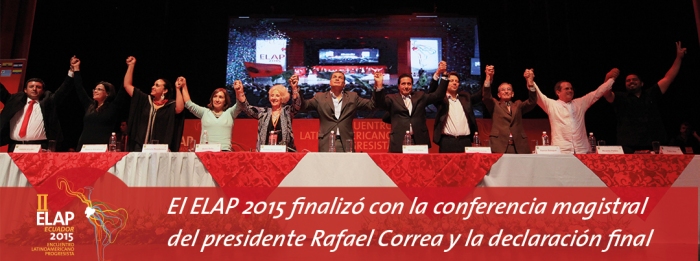
Latin American Progressive Encounter, Quito, 28-30 September 2015. Source: elapecuador.com.
The recent threats against non-governmental society organizations (NGOs) made by the avowedly progressive and environmentally-minded governments of Ecuador and Bolivia have caused commotion and discussion among academics and activists in both North and South. Last August, Bolivian vice president Alvaro García-Linera, a highly esteemed Marxist intellectual, singled out four NGOs for retaliation if they continued their “political work”. A number of high-profile international intellectuals called on García-Linera to rethink his stance.
But rather than reconsidering, the region’s progressive governments are hardening their positions, judging from the speeches delivered at the second Latin American Progressive Encounter (ELAP 2015) hosted by the Ecuadorian government in the capital city of Quito in September 28-30. The event, which had the participation of tens of political parties and movements from Latin America and Europe, featured keynote addresses by García-Linera and Ecuadorian president Rafael Correa, precisely the two public figures that have led the charge against Latin American NGOs from the left.

Etiquetas: , , , , , , ,

lunes, noviembre 09, 2015

From NACLA: Criminals or Citizens? Mining and Citizen Protest in Correa’s Ecuador

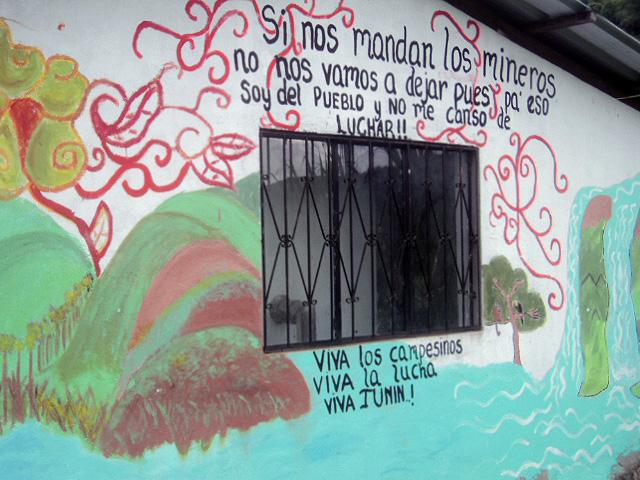
Pro-campesino anti-mining protest art on a community building in Junín (Emily Billo)

https://nacla.org/news/2015/11/02/criminals-or-citizens-mining-and-citizen-protest-correa%E2%80%99s-ecuador

Correísmo, President Rafael Correa’s particular brand of Latin American “post-neoliberal” populism, has developed a reputation for saying one thing, doing another, and criminalizing those who point out the difference. The criminalization of protest, together with state-led resource extraction, contradicts the socially minded programs of Ecuador’s 2008 Constitution. While Correa pushed for the creation of state industries to combat exploitation by multinational corporations, the development of state-owned economic enterprises is yielding a less egalitarian model than promised. Increasingly, these state industries act like foreign firms. Nowhere is this more apparent than in the way the state has marked protestors – or even those simply seeking transparency – as criminals.
According to a report by the Defensoría del Pueblo de Ecuador (2011), criminalization of protest takes two forms in Ecuador. On the one hand, the state has launched attacks against individuals. This overt criminalization has been well documented. For example, movement leaders like Javier Ramírez, who led his community of Junín against the opening of a copper mining project in the Llurimagua concession, have been incarcerated on dubious charges. President Correa has also become well known for calling environmentalists “infantile,” “romantics,” and even “terrorists.” These now emblematic cases of criminalization have been the subject of much national and international attention.
On the other hand, criminalization has become institutionalized – codified in state law and characterized by any perceived threat to the state. In 2009, for example, the state temporarily closed the well-known environmental organization, Accíon Ecológica, punishing the organization for critiques of the government and its role in anti-mining protests. Only later did state officials argue that the organization was working beyond the scope of its mission and charter. The Correa government has also argued that the organization did not register with the Ministry of Environment despite the fact the Ministry did not exist when Accíon Ecológica was founded.

Etiquetas: , , ,

viernes, mayo 02, 2014

Pachamama politics


(I am quoted in this article. Woo hoo!)

http://www.counterpunch.org/2014/04/25/the-politics-of-pachamama/

Natural Resource Extraction vs. Indigenous Rights and the Environment in Latin America

The Politics of Pachamama

by BENJAMIN DANGL


XCERPTS:

...in 2012, the Argentine state obtained 51% control of the hydrocarbon company YPF, which was privatized in the 1990s. Last year, however, Argentina’s YPF signed a deal with Chevron to expand natural gas fracking in the country, operations set to proceed on Mapuche indigenous territory. In response, indigenous communities to be affected by the fracking took over four YPF oil rigs. “It’s not just the land they are taking,” Lautaro Nahuel, of the Mapuche Confederation of Neuquén, explained to Earth Island Journal. “All the natural life in this region is interconnected. Here, they’ll affect the Neuquén River, which is the river we drink out of.” Protests against YPF-Chevron fracking plans are ongoing in the country.

Uruguayan President José “Pepe” Mujica, who has garnered international attention recently for his government’s legalization of marijuana, abortion and same sex marriage, and his offer to host released Guantanamo detainees, is moving forward with a deal with Anglo-Swiss mining group Zamin Ferrous for a major open-pit mining operation that would involve the extraction of 18 million tons of iron ore from the country over the next 12-15 years. Aside from the mining operation itself, the plan includes the construction of pipelines to ship the ore inland to the country’s Atlantic coast. Critics have pointed out that the plan would wreak havoc on the region’s biodiversity and displace local farmers. In response to the plans, a national movement is currently underway to organize a referendum to ban open pit mining in Uruguay.

While Brazil’s President Luiz Lula da Silva and his successor Dilma Rousseff, both of the Workers’ Party, have helped expand the middle class in the country, and initiated successful social programs aimed at eliminating poverty and hunger, their administrations have also presided over vast economy of extractivism that leaves no place for small farmers or environmental concerns. Brazil is home the largest mining industry in the region: in 2011 it extracted more than twice the amount of minerals than all other South American nations combined, and is the world’s largest producer of soy, a GMO crop rapidly expanding across the continent with a mixture of deadly pesticides that are killing the soil, poisoning water sources, and pushing small farmers out of the countryside and into Latin America’s urban slums.

******

...while (Ecuador's president Rafael) Correa rightfully spoke of the obligations of wealthier nations to contribute to solving the dilemmas of the global climate crisis, at home he expanded the mining industry and criminalized indigenous movements who protested extractive industries in their territories. Under his administration, numerous indigenous leaders organizing against mining, water privatization measures, and hydrocarbon extraction have been jailed for their activism.


The (Bolivian) government has advocated for a plan to build a major highway through the TIPNIS indigenous territory and national park. Protests against the government plans galvanized a movement for indigenous rights and environmentalism. In response, the government led brutal repression against families marching in protest of the highway in 2011. Government violence left 70 wounded; victims and their families and allies are still searching for justice.

Etiquetas: , ,