viernes, agosto 16, 2013

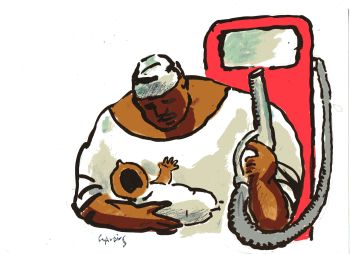
Patzek: The Earth's plants produce exactly what others eat

by Tad Patzek, originally published by Life Itself 


TO READ THE FULL ARTICLE:
http://www.resilience.org/stories/2013-07-03/the-earth-s-plants-produce-exactly-what-others-eat


I would like to remind those readers who might be scientifically-challenged that the laws of physics, chemistry, and biology are called "laws," because we, scientists, have found no exceptions to them in as many experiments as have been carried out for as long as these laws have been on the books.  I repeat: As opposed to legal laws, the laws of nature do not allow exceptions, no matter how much money and effort is spent by the corrupt corporations, corrupt academics, clueless reporters, and other drug dealers to hide this fact from the society.

Just like ignorance of the law cannot be a legal excuse, ignorance of the laws of nature is a crime, not an oops. But, because most societies do not care much about nature, this crime generally goes unpunished by human laws.  In the long run, however, trespassing against the laws of nature has only one outcome: We perish by one means or another.  Since this perishing is distributed over space and time, most people do not make the connection.  So think about all the cancer cases among the people you knew and remember.  Or all the ADD or autistic children you know or have met.  Or all the diabetics you know or have met. Did you notice how many people have rampant allergies? How much do you know about the Roundup-resistant super-weeds that crop up everywhere? How many people die in hospitals from deadly infections caused by the methicillin resistant Staphylococcus aureus (MRSA) superbug? What do you know about giant pig farms and cow feedlots? And so on...


June 22, 2013: This suffocating haze in Singapore is caused by the runaway fires devouring the tropical forest and peat in the neighboring Indonesia.  The vast swaths of natural forest in Indonesia have been burned illegally by investors mostly from Singapore and Malaysia to establish the giant plantations of oil palms for biodiesel, food, and cosmetics.  Cumulatively over 10 million hectares of the pristine tropical forest have been eliminated in Indonesia. The carbon dioxide emissions from burning forests in Indonesia alone rival all of the emissions from all of the sources on the entire Earth.  Of course, agrofuel advocates talk incessantly about the huge reductions of gas emissions from burning biofuels.

Etiquetas: , , ,

martes, diciembre 06, 2011

Biofuels Are Not the Solution

"We have to stop all false solutions, including large-scale agrofuels. We should instead urgently invest in the real solutions, such as reducing consumption, improving energy efficiency, switching to clean renewable energy and to sustainable local food production."

 / Credit:Claudius/IPS
By Nnimo Bassey
ipsnews.net
Science tells us that we are heading for a climate crisis, yet it is within our means to change course.

* Nnimmo Bassey is the current chair of Friends of the Earth International and executive director and founding member of Environmental Rights Action.

Etiquetas: , , ,

viernes, octubre 22, 2010

Biofuel billionaires

U.S. Secretary of Agriculture Confronted at Press Conference by ‘Billionaires’


For Immediate Release
Thursday, October 21, 2010

Contact:
Kelly Trout, 202-222-0722, ktrout@foe.org
Josef Palermo, 202-222-0742, jpalermo@foe.org

U.S. Secretary of Agriculture Confronted at Press Conference by ‘Billionaires’

Activists stage demonstration criticizing USDA Secretary Tom Vilsack’s plan to increase production of dirty ethanol and build its infrastructure with taxpayer dollars

WASHINGTON, D.C. — Friends of the Earth showed up at a press conference held by Agriculture Secretary Tom Vilsack this morning to protest his newly announced support for extending federal subsidies to ethanol. Several activists, dressed as “Billionaires for Biofuels,” mocked the corporate corn ethanol industry groups responsible for duping the Obama administration into falsely believing ethanol to be a form of clean energy worthy of billions of dollars in government handouts.

“We’ve already paid billions of dollars to develop this unsustainable fuel,” said Kate McMahon, biofuels campaign coordinator with Friends of the Earth. “Now, the corporate interests behind ethanol want us, the American taxpayers, to pay them billions more to continue polluting our planet.”

The “Billionaires for Biofuels” included satirical representatives of ethanol lobby groups Growth Energy, the Renewable Fuels Association, the American Coalition for Ethanol, and the National Corn Growers Association, and publicly thanked the Obama administration and passersby for American tax dollars that support the ethanol industry. The “billionaires” were joined by other activists holding a banner reading, “Save Tax Dollars—And The Planet: Stop Federal Support of Ethanol.”

Secretary Vilsack’s press event came after the ethanol lobbyist groups met behind closed doors with President Obama’s new Chief of Staff, Pete Rouse, earlier this month to push ethanol as a fuel the White House could endorse as clean. The plan the corporate ethanol interests are pressing for includes federal loan guarantees for ethanol pipelines, the false labeling of corn-starch ethanol as an “advanced” biofuel under the existing federal ethanol production mandate, and the suspension of requirements that all pollution from corn ethanol production, including that caused by indirect land use change, be counted.

According to the EPA, corn ethanol creates more greenhouse gas emissions than regular gasoline, and also contaminates the Gulf of Mexico with nitrogen fertilizer runoff that travels down the Mississippi River – creating “dead zones” long before the BP oil spill.

“Our objective with today’s street theater demonstration is to show the absurdity of the Obama administration’s continued support for ethanol, and how it comes at the expense of taxpayers and the environment,” McMahon said. “The EPA’s recent decision to allow increased amounts of ethanol to be put into in gasoline is an example of this.”

Friends of the Earth and its allies have been campaigning to end the Volumetric Ethanol Excise Tax Credit, which provides billions of dollars in subsidies to the corn ethanol industry by way of the oil industry each year, even though the oil industry is already required by law to blend ethanol into gasoline.

###

Friends of the Earth and our network of grassroots groups in 77 countries fight to create a more healthy, just world. Our current campaigns focus on clean energy and solutions to climate change, keeping toxic and risky technologies out of the food we eat and products we use, and protecting marine ecosystems and the people who live and work near them.

Etiquetas: , , ,

miércoles, junio 02, 2010

Earth Policy Institute


Earth Policy Release
Book Byte
June 1, 2010

CARS AND PEOPLE COMPETE FOR GRAIN

www.earthpolicy.org/index.php?/book_bytes/2010/pb4ch02_ss6

By Lester R. Brown

Plan B 4.0: Mobilizing to Save Civilization by Lester R. BrownAt a time when excessive pressures on the earth's land and water resources are of growing concern, there is a massive new demand emerging for cropland to produce fuel for cars—one that threatens world food security. Although this situation had been developing for a few decades, it was not until Hurricane Katrina in 2005, when oil prices jumped above $60 a barrel and U.S. gasoline prices climbed to $3 a gallon, that the situation came into focus. Suddenly investments in U.S. corn-based ethanol distilleries became hugely profitable, unleashing an investment frenzy that will convert one fourth of the 2009 U.S. grain harvest into fuel for cars.

The United States quickly came to dominate the crop-based production of fuel for cars. In 2005, it eclipsed Brazil, formerly the world's leading ethanol producer. In Europe, where the emphasis is on producing biodiesel, mostly from rapeseed, some 2.4 billion gallons were produced in 2009. To meet its biodiesel goal, the European Union, under cropland constraints, is increasingly turning to palm oil imported from Indonesia and Malaysia, a trend that depends on clearing rainforests for oil palm plantations.

The price of grain is now tied to the price of oil. Historically the food and energy economies were separate, but now with the massive U.S. capacity to convert grain into ethanol, that is changing. In this new situation, when the price of oil climbs, the world price of grain moves up toward its oil-equivalent value. If the fuel value of grain exceeds its food value, the market will simply move the commodity into the energy economy. If the price of oil jumps to $100 a barrel, the price of grain will follow it upward. If oil goes to $200, grain will follow.
Ethanol
Credit: iStock Photo / Vasata Studio


From 1990 to 2005, world grain consumption, driven largely by population growth and rising consumption of grain-based animal products, climbed by an average of 21 million tons per year. Then came the explosion in grain used in U.S. ethanol distilleries, which jumped from 54 million tons in 2006 to 95 million tons in 2008. This 41-million-ton jump doubled the annual growth in world demand for grain almost overnight, helping to triple world prices for wheat, rice, corn, and soybeans from mid-2006 to mid-2008. A World Bank analyst attributes 70 percent of the food price rise to this diversion of food to produce fuel for cars. Since then prices have subsided somewhat as a result of the global economic downturn, but they are still well above historical levels.

From an agricultural vantage point, the world's appetite for crop-based fuels is insatiable. The grain required to fill an SUV's 25-gallon tank with ethanol just once will feed one person for a whole year. If the entire U.S. grain harvest were to be converted to ethanol, it would satisfy at most 18 percent of U.S. automotive fuel needs.


Projections by Professors C. Ford Runge and Benjamin Senauer of the University of Minnesota in 2003 showed the number of hungry and malnourished people decreasing steadily to 2025. But their early 2007 update of these projections, which took into account the biofuel effect on world food prices, showed the number climbing rapidly in the years ahead. Millions of people living on the lower rungs of the global economic ladder, who are barely hanging on, are losing their grip and beginning to fall off.


Since the budgets of international food aid agencies are set well in advance, a rise in food prices shrinks food assistance. The World Food Programme, which is now supplying emergency food aid to more than 30 countries, cut shipments as prices soared. Hunger is on the rise, with some 18,000 children dying each day from hunger and related illnesses.


The emerging competition between the owners of the world's 910 million automobiles and the 2 billion poorest people is taking the world into uncharted territory. Suddenly the world is facing an epic moral and political issue: Should grain be used to fuel cars or feed people? The average income of the world's automobile owners is roughly $30,000 a year; the 2 billion poorest people earn on average less than $3,000 a year. The market says, let's fuel the cars.


For every additional acre planted to corn to produce fuel, an acre of land must be cleared for cropping elsewhere. But there is little new land to be brought under the plow unless it comes from clearing tropical rainforests in the Amazon and Congo basins and in Indonesia or from clearing land in the Brazilian cerrado. Unfortunately, this has heavy environmental costs: a massive release of sequestered carbon, the loss of plant and animal species, and increased rainfall runoff and soil erosion.

While it makes little sense to use food crops to fuel cars if it drives up food prices, there is the option of producing automotive fuel from fast-growing trees, switchgrass, prairie grass mixtures, or other cellulosic materials, which can be grown on wasteland. The technologies to convert these cellulosic materials into ethanol exist, but the cost of producing cellulosic ethanol is close to double that of grain-based ethanol. Whether it will ever be cost-competitive with ethanol from grain is unclear.


There are alternatives to this grim scenario. The decision in May 2009 to raise U.S. auto fuel efficiency standards 40 percent by 2016 will reduce U.S. dependence on oil far more than converting the country's entire grain harvest into ethanol could. The next step is a comprehensive shift to gas-electric plug-in hybrid cars that can be recharged at night, allowing most short-distance driving—daily commuting and grocery shopping, for example-to be done with electricity. An even more fundamental need is to
restructure transportation systems to provide far more options than the personal automobile.

As the leading grain exporter and ethanol producer, the United States is in the driver's seat. It needs to make sure that efforts to reduce its heavy dependence on imported oil do not create a far more serious problem: chaos in the world food economy. The choice is between a future of rising world food prices, spreading hunger, and growing political instability and one of more stable food prices, sharply reduced dependence on oil, and much lower carbon emissions.

# # #

Adapted from Chapter 2, "Population Pressure: Land and Water" in Lester R. Brown,
Plan B 4.0: Mobilizing to Save Civilization
(New York: W.W. Norton & Company, 2009),
available on-line at www.earthpolicy.org/index.php?/books/pb4.

Etiquetas: , , ,

sábado, mayo 15, 2010

Biofuels do little to help the climate: Reform of EU regulations is needed

By Finfacts Team

May 14, 2010

Biofuels possibly have a negative impact on the concentration of greenhouse gases (GHGs) in the atmosphere under current EU regulations.


Using cultivated land to produce the biomass for biofuels results in new land being cleared for the purpose of producing food. In extreme cases, the new land cleared is in tropical forests. Since this can generate considerable amounts of GHGs, the use of biofuels under the current regulations hardly helps the climate. Only by reforming the sustainability requirements for producing biofuels, will they have a positive benefit. This is the main finding of a study conducted by Mareike Lange, of the German Kiel Institute for the World Economy, which she has published together with Dominique Bruhn as a Kiel Policy Brief.

The authors say biofuels remain an important element of the EU strategy for reducing GHGs. The EU plans to be able to use renewable, nonfossil energy sources to cover at least 10 percent of energy used in the transportation sector by 2020, and biofuels are the most important such source.

READ THE REST:
http://www.finfacts.ie/irishfinancenews/article_1019687.shtml


Etiquetas: ,

miércoles, abril 14, 2010

The trouble with Brazil’s much-celebrated ethanol ‘miracle’

Grist admin avatar badge avatar for Tom Philpott

by Tom Philpott


ethanolNot as sweet as advertised: industrial-scale sugarcane production in Brazil.This is a post about Brazil's sugarcane-ethanol "miracle," but I can't resist starting off with a look askance at our own corn-derived ethanol phenomenon. Has there ever been a "green" technology more ecologically discredited than corn-based ethanol?

It may yield slightly more energy than it consumes during production--but only if you grant a generous credit to distillers grains, an ethanol byproduct now busily being shoveled into CAFOs (and exported to China) as a highly dubious livestock feed. But corn ethanol's unimpressive energy balance makes it a pathetic candidate to displace energy-rich petroleum gasoline.

Moreover, its total greenhouse gas emissions are likely titanic--a fact limply acknowledged by the EPA and then eventually retracted under industry pressure. For the love of God, the stuff is based on industrial corn--by far our biggest user of soil-degrading synthetic nitrogen fertilizer.

Yet the corn-ethanol behemoth lurches tediously along, forever demanding, and too often commanding, ever-spiralling amounts of government support and arable land. Sigh.

Too bad we're not more like Brazil, where they're displacing petroleum with highly efficient sugarcane-based ethanol ... right? Well, no. In 2006, I co-wrote an article about what Brazil's much-heralded cane ethanol revolution has to teach the United States. The conclusion: not much.

Now comes this blistering report from Foreign Policy magazine exposing the myth that sugarcane ethanol is some sort of environmental panacea.

Before I get to the details, I want to make the point that the biofuel-as-panacea impulse is only possible in society's whose citizens fundamentally don't understand agriculture. Biofuels are hailed as "renewable," because crops can be grown on the same land year after year. But monocrops destroy soil--properly thought of as a non-renewable resource--and require lots of agrichemical poisons. Therefore, industrial-scale biofuels aren't renewable. (Whether biofuels can work sustainably in regional niches, as part of a diverse cropping system, is a different question).

Okay, where was I? In the FP piece, author Nikolas Kozloff jumps right to the point in his lead:

While sugar cane ethanol is certainly less ecologically destructive than some other biofuels, the industry's boosters have overlooked one key fact: You've got to plant sugar cane somewhere. One couldn't pick a worse place to harvest cane than Brazil's Atlantic rainforest. There, sugar cane crops have led to deforestation and, paradoxically, more carbon emissions.

He goes on to explain that the flattening of the Atlantic rainforest--distinct from the Amazonian one--stands as the original sin of Portugal's colonization of Brazil. The history of several tropical crops we now take for granted--for example sugarcane and coffee--is essentially the history of razing of that vast forest (twice the size of Texas, with as much biodiversity as the Amazon forest). And this ecological crime was compounded by the use of slave labor, Kozloff reminds us. "The colonists shipped six million African slaves to Brazil to do the cutting," he writes: surely one of the vilest episodes in human history.

READ THE REST AT: http://www.grist.org/article/2010-04-13-raising-cane-the-trouble-with-brazils-much-celebrated-ethanol-mi/

Etiquetas: , , , ,

miércoles, abril 07, 2010

Etiquetas: , ,

viernes, marzo 12, 2010


The Case Against Biofuels:
Probing Ethanol’s Hidden Costs

by c. ford runge

Despite strong evidence that growing food crops to produce ethanol is harmful to the environment and the world’s poor, the Obama administration is backing subsidies and programs that will ensure that half of the U.S.’s corn crop will soon go to biofuel production. It’s time to recognize that biofuels are anything but green.

Etiquetas: , , ,

lunes, octubre 26, 2009

Biofuels: not so groovy after all

From World War 4 Report

Although still blind to the related human rights violations, the scientific community finally acknowledges that "biofuels" fuel deforestation—and thereby result in a net increase in greenhouse gas emissions. Here's the abstract of the story that appears in the Oct. 22 edition of Science, "Fixing a Critical Climate Accounting Error":

The accounting now used for assessing compliance with carbon limits in the Kyoto Protocol and in climate legislation contains a far-reaching but fixable flaw that will severely undermine greenhouse gas reduction goals. It does not count CO2 emitted from tailpipes and smokestacks when bioenergy is being used, but it also does not count changes in emissions from land use when biomass for energy is harvested or grown. This accounting erroneously treats all bioenergy as carbon neutral regardless of the source of the biomass, which may cause large differences in net emissions. For example, the clearing of long-established forests to burn wood or to grow energy crops is counted as a 100% reduction in energy emissions despite causing large releases of carbon.

The standard "does not count CO2 emitted from tailpipes and smokestacks when bioenergy is being used"? What's up with that? Turns out the folks who wrote the Kyoto Protocol just took the biofuel industry's word for it! From Reuters, Oct. 22:

U.S. ethanol industry group the Renewable Fuels Association said biofuels are by definition emissions neutral because their tailpipe carbon output is absorbed by growing plants.

A cute little propaganda scam, eh? Obviously panicked that their cover has been blown, Biomass Magazine quickly retorts:

Biofuels produced from biomass feedstocks (i.e. plant matter) are, by definition, carbon neutral because carbon dioxide tailpipe emissions from the combustion of biofuels are readily absorbed by growing plants. As such, the tailpipe emissions resulting from the use of a gallon of ethanol produced from corn grown on U.S. farmland are negated by the growing of the corn itself.

Yet, in a newly published article in Science, frequent biofuel critics Tim Searchinger, Dan Kammen, and others argue that this widely held scientific convention is erroneous. They argue that biofuels and other biobased energies should be accountable for the biogenic tailpipe and "smokestack" CO2 emissions that are absorbed by growing feedstocks and carbon emissions that could result from land clearing. The authors argue that existing and proposed regulations, such as the so-called U.S. cap and trade bill, create an accounting loophole that will lead to increased deforestation. They conceptually propose an unnecessary and impossible system that would trace actual flows of carbon.

However, the release of CO2 from recently living organisms has no overall effect on atmospheric CO2 levels and is therefore carbon neutral because atmospheric CO2 decreases when a plant photosynthesizes, then increases back to its initial level when that carbon (in the form of a biofuel) is burned and returned to the atmosphere. In this way, biofuels "recycle" organic carbon.

Now by what logical contortions do they conclude that "CO2 from recently living organisms has no overall effect on atmospheric CO2 levels"? And does a field of "biomass feedstocks" absorb as much carbon as a forest—putting aside the issues of biodiversity, watershed protection, cultural survival for indigenous forest-dwellers, etc.? Let's see what some other voices have to say on the question.

From the Union of Concerned Scientists:

Clearing mature forests and replacing them with fast-growing younger trees is not a solution. To be sure, younger trees draw carbon out of the atmosphere more quickly. But cutting down mature forests releases large quantities of CO2. And replacing natural forests with tree plantations destroys biodiversity—the web of life that supports and nourishes all plants and animals.

From the World Rainforest Movement:

Even if OECD countries are responsible for 77% of the world fossil fuel-related emissions of CO2...they advocate for a "solution" that consists on using the photosynthetic activity of tree leaves to capture CO2 and retain carbon in the wood. These so-called "carbon sinks" are fast-growing species' plantations to be installed in the South. The model is simple: the North will continue emiting CO2 to the atmosphere and the South will be responsible of capturing it throught the new installed "forest cover". They call it "joint implementation" and is the most recent argument used by plantation promoters to justify their activity. According to one calculation, 300 million hectares of fast-growing trees are required to absorb the annual global emissions of CO2 if the present rate of emissions continues, as is expected. There’s no scientific evidence of their efficiency, since their capacity to capture CO2 can be much influenced by climate change...

Such plantations have little in common with forests. Consisting of thousands or even millions of trees of the same species, bred for rapid growth, uniformity and high yield of raw material and planted in even-aged stands, they require intensive preparation of the soil, fertilisation, planting with regular spacing, selection of seedlings, mechanical or chemical weeding, use of pesticides, thinning, and mechanized harvesting... Industrial tree plantations have in many cases been preceded by firing or clearcutting of native forests and have therefore become a new and major cause of deforestation.

From the Global Justice Ecology Project:

The expansion of oil palm plantations usually takes place at the expense of transforming natural ecosystems, particularly tropical rainforests. This has disastrous consequences... [T]he destruction of the forest implies the release of carbon dioxide (CO2) - one of the greenhouse effect gases, whose accumulation in the atmosphere is responsible for global warming and subsequently climate change. Moreover, if a comparative assessment of CO2 is made between the two systems (forests and plantations), it will be seen that tropical forests, because of their complexity, store and absorb much more carbon than plantations.

If you folks at Biomass Magazine think you have persuasive answers to these arguments, we'd love to hear from you. Really.

See our last post on the climate crisis.

Etiquetas: , , ,

domingo, abril 19, 2009

April 14, 2009

The Dubious Revolution

Biofuels, the Next Generation

By CARMELO RUIZ-MARRERO

The promotion of biofuels is a central component of president Obama's energy policy. But biofuel crops, which are mostly corn, sugar cane, oil palm and soy, are in big trouble because of the overwhelming and continuously growing evidence of the environmental harm that they cause. And besides, all large-scale industrial agriculture requires large amounts of fossil fuel, so biofuels are hardly a cure for petroleum addiction.

The Obama administration and an increasing number of biofuel supporters acknowledge these problems but they wager that these will be solved by a new generation of biofuels made from cellulose.

And what's so great about cellulose? For one, it is everywhere. Cellulose is the most common organic compound on earth and a key structural component of the cell walls of green plants and many forms of algae. About one third of all plant matter in the world is cellulose.

In spite of the best efforts of scientists, the cellulose molecule stubbornly resists all cost-effective attempts at transforming it into fuel. So they are now looking to nature for answers: fungi and certain bacteria found in the guts of termites and ruminant mammals (such as cows) that produce enzymes that can digest cellulose.

The ability to turn cellulose into fuel would make it possible to use any vegetable matter, living or dead, to this end- corn stalks, suburban lawn clippings, dead wood, you name it. According to their enthusiastic supporters, the main advantage of cellulose-based fuels is that they will not compete with food crops. You can get a Nobel prize for less than this.

And that's where biotechnology comes in. The biotech industry proudly claims to be a major player in both the energy business and global warming prevention strategies by virtue of its cutting edge research and development into, among other things, cellulose biofuels.

The president's cabinet is equal to the task. When he was Iowa governor, current agriculture secretary Tom Vilsack was named Governor of the Year 2001 by the Biotechnology Industry Organization for his passionate defense of the biotech industry and its products. And energy secretary Steven Chu was the main architect of a controversial $500 million dollar deal between the BP corporation and the University of California's Berkeley campus. This money, a sum that has no precedent in the history of academia, will be used to develop novel biofuels through biotechnology.

But some scientists and environmentalists warn that the cellulose boom will in no way solve the problems of the current generation of biofuels, and in fact will create new ones.

Last January a coalition of diverse groups, that included Food First and the Institute for Social Ecology, issued an open letter that denounced biofuels as a false solution to global warming and specifically contested the assertion that cellulose-based fuel production will not compete with food production.

The open letter's basic arguments are not new at all. Back in 2007 a group of eleven non-governmental organizations, from countries such as Argentina, Indonesia and Denmark, produced a report titled “Agrofuels: Towards a Reality Check”. The document was particularly emphatic in warning that using so-called agriculture “waste” to meet global energy needs is not a smart idea at all.

What the numerous objections to the biofuels revolution- whether the current generation or yet-to-exist biotech fuels- come down to is that the feedstock for this energy source must come from somewhere. Looking at the promo literature for new generation biotech biofuels one gets the impression that these are made out of thin air. But the fact is that all those fuels come from organisms, hence the prefix “bio”. And all those organisms, whether they be farm crops or engineered microbes, ultimately need to be nourished with physical inputs like nutrients and water, which are not cheaply available. They are renewable but not infinite.

So how much raw material would the cellulose boom require? The U.S. Departments of Energy and Agriculture set out to find the answer and in 2005 issued a joint report which concluded that the use of wood, grasses, and "plant waste" for the production of cellulosic ethanol would require 1.3 billion tons of dry biomass a year. Obtaining this amount would be possible only by removing most of the country's agricultural residues, planting an area three times the size of Missouri with perennial cellulose-rich crops like switchgrass, and putting all U.S. farmland under "no-till" agriculture, say the report's authors.

In these times of economic and ecological collapse it is hard not to get carried away by the lure of technological quick fixes, like biofuels. I beg to differ from most renewable energy advocates: this is not a matter of “bad” non-renewable energy sources vs. “good” renewable ones. The ultimate root problem behind environmental catastrophe and the energy crisis is the voracious and ever-increasing energy demand, which unfortunately many environmentalists and eco-entrepreneurs have come to accept as a given.

Rather than jumping headlong into a dubious biofuels revolution, our best bet for survival will be the realization that increased energy consumption and higher standards of living are not synonymous.

Carmelo Ruiz-Marrero, a self-described renaissance hack and impractical humanist, is a Puerto Rican journalist, environmental educator and author. He is as Senior Fellow of the Environmental Leadership Program, a Fellow of the Oakland Institute, and directs the Puerto Rico Project on Biosafety (http://bioseguridad.blogspot.com/). Whenever he is not writing or working at a call center, he distributes farm produce for something that resembles a CSA. Ruiz-Marrero, a compulsive blogger, blogs away at: http://carmeloruiz.blogspot.com/


SOURCE: http://counterpunch.org/ruiz04142009.html

Etiquetas: , , , ,

jueves, marzo 19, 2009

From George Monbiot's blog:

Shell's subtle switch from renewables to the murky world of 'alternative' energy

Shell's spending on renewables – except biofuel – appears to have fallen from $200m a year to zero over the past nine years

The Royal Dutch Shell headquarters in The Hague

So at last we have an explanation. During my video interview with Jeroen van der Veer, the chief executive of Shell, I asked the same question 15 times: "What is the value of your annual investments in renewable energy?"

After several attempts to change the subject, he admitted that he knew the figure, then flatly refused to reveal it. Nor could he give me a convincing explanation of why he wouldn't tell me, claiming only that "those figures are misused and people say it is too small" and it "is not the right message to give to the people".

Yesterday, Shell announced that it has stopped investing in conventional renewables: wind, solar and hydro. It will concentrate instead on developing second-generation biofuels. There are a number of possible reasons for this shift:

• Shell's portfolio was spread too thinly

• Carbon prices, which reflect the carbon caps imposed by governments, are extremely low. Without some major policy shifts, they are likely to stay that way, which means that renewables are an unattractive investment

• The prospect of a liquid fuels-crunch caused by declining oil reserves means that Shell will get better returns for its money by investing in tar sands and biofuels than by investing in electricity supply

• Greenwash isn't working any more. Some of us suspected that the primary purpose of Shell's investment in renewables was public relations. Though he did not express himself clearly on this point, van der Veer appeared to concede in our interview that some of the company's advertising had not been honest:

If we are very big in oil and gas and we are so far relatively small in alternative energies, if you then every day only make adverts about your alternative energies and not about 90% of your other activities ... then I say transparency, honesty to the market, that's nonsense.

So much for speculation. This week I received a leaked extract of van der Veer's latest newsletter to his staff. It says:

Finally, let me update you on our renewable energy activities. As you know, our strategy is to investigate a range of alternative energy and CO2 technologies. We spent about $1.7bn on them in the last five
years. The one that is closest to our core business is sustainable biofuels. That's where we'll focus in 2009 and 2010. So as you can see, we're making good progress. We are on track with our strategy and our projects, building the foundations of our future. Thank you for contributing to our momentum!

Now this is really confusing. The obvious explanation for van der Veer's refusal to give me a figure for current investments – which appears to be supported by the comments he made – is that they had fallen from the previous level of spending. In 2000, the company had boasted that it would be investing $1bn dollars in renewable energy between 2001 and 2005.

So why, if its spending over the past five years has risen by 70%, wouldn't he tell me? He didn't even try the obvious excuse – that the figure was "commercially confidential".

My guess is that the difference hinges on definition. You'll notice than in the newsletter he switches from "renewables" to "alternative energy and CO2 technologies". Alternative energy is not necessarily renewable energy. The figure might include the cost of assessing the prospects of exploiting oil shales, for example – an extremely polluting fuel source, from which it takes a great deal of energy to extract liquid fuels.

In our interview, van der Veer conceded that this was something Shell had been researching. The CO2 technologies might refer to investigating the prospect of capturing carbon from Shell's tar sands operation. Alternatively, the money might all be going into biofuels.

So perhaps there is no conflict between these figures. Shell's spending on renewables – except biofuel – appears to have fallen from $200m a year to zero over the past nine years. Its spending on liquid fuel production of all kinds has risen. Shell is consolidating: has it stopped pretending to be anything other than a liquid fuel and gas company?

The big question now, however, is this: without a strong carbon price, who is going to invest in renewables?

Monbiot.com

Etiquetas: , , ,

domingo, marzo 08, 2009

70 Percent More Energy Required to Make Ethanol than Actually is in Ethanol: Cornell

CU scientist terms corn-based ethanol 'subsidized food burning'

Neither increases in government subsidies to corn-based ethanol fuel nor hikes in the price of petroleum can overcome what one Cornell agricultural scientist calls a fundamental input-yield problem: It takes more energy to make ethanol from grain than the combustion of ethanol produces.

At a time when ethanol-gasoline mixtures (gasohol) are touted as the American answer to fossil fuel shortages by corn producers, food processors and some lawmakers, Cornell's David Pimentel takes a longer range view.

"Abusing our precious croplands to grow corn for an energy-inefficient process that yields low-grade automobile fuel amounts to unsustainable, subsidized food burning," said the Cornell professor in the College of Agriculture and Life Sciences. Pimentel, who chaired a U.S. Department of Energy panel that investigated the energetics, economics and environmental aspects of ethanol production several years ago, subsequently conducted a detailed analysis of the corn-to-car fuel process. His findings will be published next month in the forthcoming Encyclopedia of Physical Sciences and Technology.

Among his findings:

* An acre of U.S. corn yields about 7,110 pounds of corn for processing into 328 gallons of ethanol. But planting, growing and harvesting that much corn requires about 140 gallons of fossil fuels and costs $347 per acre, according to Pimentel's analysis. Thus, even before corn is converted to ethanol, the feedstock costs $1.05 per gallon of ethanol.

* The energy economics get worse at the processing plants, where the grain is crushed and fermented. As many as three distillation steps are needed to separate the 8 percent ethanol from the 92 percent water. Additional treatment and energy are required to produce the 99.8 percent pure ethanol for mixing with gasoline.

* Adding up the energy costs of corn production and its conversion to ethanol, 131,000 Btu are needed to make 1 gallon of ethanol. One gallon of ethanol has an energy value of only 77,000 Btu. "Put another way," Pimentel said, "about 70 percent more energy is required to produce ethanol than the energy that actually is in ethanol. Every time you make 1 gallon of ethanol, there is a net energy loss of 54,000 Btu."

* Ethanol from corn costs about $1.74 per gallon to produce, compared with about 95 cents to produce a gallon of gasoline. "That helps explain why fossil fuels -- not ethanol -- are used to produce ethanol," Pimentel said. "The growers and processors can't afford to burn ethanol to make ethanol. U.S. drivers couldn't afford it either, if it weren't for government subsidies to artificially lower the price."

* Most economic analyses of corn-to-ethanol production overlook the costs of environmental damages, which Pimentel says should add another 23 cents per gallon. "Corn production in the U.S. erodes soil about 12 times faster than the soil can be reformed, and irrigating corn mines groundwater 25 percent faster than the natural recharge rate of ground water. The environmental system in which corn is being produced is being rapidly degraded. Corn should not be considered a renewable resource for ethanol energy production, especially when human food is being converted into ethanol," Pimentel said.

* The approximately $1 billion a year in current federal and state subsidies (mainly to large corporations) for ethanol production are not the only costs to consumers, the Cornell scientist observes. Subsidized corn results in higher prices for meat, milk and eggs because about 70 percent of corn grain is fed to livestock and poultry in the United States. Increasing ethanol production would further inflate corn prices, Pimentel said, noting: "In addition to paying tax dollars for ethanol subsidies, consumers would be paying significantly higher food prices in the marketplace."

Nickels and dimes aside, some drivers still would rather see their cars fueled by farms in the Midwest than by oil wells in the Middle East, Pimentel acknowledges, so he calculated the amount of corn needed to power an automobile:

* The average U.S. automobile, traveling 10,000 miles a year on pure ethanol (not a gasoline-ethanol mix), would need about 852 gallons of the corn-based fuel. This would take 11 acres to grow, based on net ethanol production. This is the same amount of cropland required to feed seven Americans.

* If all the automobiles in the United States were fueled with 100 percent ethanol, a total of about 97 percent of U.S. land area would be needed to grow the corn feedstock. Corn would cover nearly the total land area of the United States.

Etiquetas: , ,

jueves, febrero 19, 2009

SIERRA CLUB AND WORLDWATCH FUMBLE ON BIOFUELS

This report should be regarded with skepticism and concern. Its authors are good at pointing out the pitfalls and problems of biofuels but in the end- and against all logic- conclude that biofuel production can be made sustainable with a few reforms here and there. They assume from the start that biofuels are desirable and inevitable. The industrialized North's voracious and irresponsible consumption is unadressed, and endless economic growth remains unquestioned. Reports like these can do more harm than good, since their most immediate and obvious effect will be to confound and divide the environmental movement on this issue.


- CARMELO

----- Forwarded Message ----
From: Julia Tier

FOR IMMEDIATE RELEASE

February 18, 2009

Contact:

Josh Dorner, Sierra Club, 202.675.2384

Julia Tier, Worldwatch Institute, 202.452.1992, ext. 594

Time to Get “Smart” on Biofuels

Sierra Club, Worldwatch Institute Outline “Smart Choices for Biofuels” in New Report

Washington, D.C.—The Sierra Club and Worldwatch Institute today released a report, Smart Choices for Biofuels, highlighting the need for important policy reforms at this critical juncture in America’s effort to increase the use of biofuels. The report outlines the economic and environmental impacts of first-generation biofuels such as corn ethanol, proposes strategies to make the biofuels industry more sustainable, and offers specific policy recommendations in four broad categories:

  • Developing sustainability standards
  • Advancing biofuels production and new technologies
  • Creating green jobs through biofuels
  • Promoting policy coherence across energy sectors

“At a time of volatile gas prices and rising concern about global warming, it has become clear that biofuels can play a role in reducing dependence on oil and curbing climate change,” said Christopher Flavin, President of Worldwatch Institute. “However, the large and growing scale of the industry make it critical that Congress now make smart choices that promote sustainable biofuels—rather than just more biofuels—as part of a clean energy economy.”


SE RENTA APARTAMENTO #703 en Edificio Darlington de Río Piedras. Avenida Muñoz Rivera #1007. (787) 781-8522, 771-4473, 203-2615. Para residencia u oficina.


U.S. biofuels production in 2008 topped 9 billion gallons—the vast majority of which was corn ethanol—and successive Congressional mandates call for the use of 36 billion gallons of biofuels by the year 2022. Domestic biofuels output has more than doubled since 2005, and the report explores the many issues associated with this dramatic increase in the production of renewable fuels, including: the global warming emissions profile of corn ethanol; the effect on the Conservation Reserve Program; other effects on the nation’s air, water, and land; and the lower-than-expected economic benefits for rural communities.

“The headlong rush toward biofuels—corn ethanol in particular—has had many consequences, some foreseen and others not,” said Carl Pope, Sierra Club Executive Director. “The downside risks to our land, air, water, and economy have become readily apparent, but the good news is that with smart choices we can make biofuels work for the environment, economy, and climate, while enhancing our energy security.”

Smart Choices for Biofuels maps a future path for biofuels to ensure that they are more environmentally and socially sustainable and that the use of renewable fuels for transportation contributes to the global effort to reduce global warming pollution. The steps proposed in the report include an accelerated transition to cellulosic feedstocks such as switchgrass and the use of more effective agricultural practices to decrease erosion and soil nutrient depletion. The report also recommends complementary steps beyond improvements in biofuels production, such as the promotion of plug-in hybrid vehicles and increased investments in public transportation, which could also help achieve crucial energy and climate goals.

Finally, the report concludes that if a renewable fuels mandate is to contribute effectively to reducing foreign oil dependence and curbing global warming, it must be reevaluated in light of changing circumstances. Changes in four broad policy categories—sustainability standards, advancing biofuels production and new technologies, creating green jobs, and promoting policy coherence across energy sectors—are detailed in the report.

Sierra Club and Worldwatch Institute previously collaborated on biofuels and sustainability when they released a report in October 2007 focused solely on Iowa , titled Destination Iowa : Getting to a Sustainable Biofuels Future.

The full Smart Choices for Biofuels report is available online at: www.worldwatch.org/smartchoicesforbiofuels

Etiquetas: , , ,

lunes, febrero 09, 2009

Study Finds that Biofuels Require Increased Fossil Fuel Usage and Take Food off Peoples' Tables


Study highlights problems linked to converting crops into biofuels. Taking up valuable land and growing edible crops for biofuels poses a dilemma: Is it ethical to produce inefficient renewable energies at the expense of an already malnourished population?

David Pimentel and his colleagues from Cornell University in New York State highlight the problems linked to converting a variety of crops into biofuels. Not only are these renewable energies inefficient, they are also economically and environmentally costly and nowhere near as productive as projected. Their findings are published online in Springer's journal Human Ecology.

In the context of global shortages of fossil energy - oil and natural gas in particular - governments worldwide are focusing on biofuels as renewable energy alternatives. In parallel, almost 60 percent of the world's population is malnourished increasing the need for grains and other basic foods. Growing crops, including corn, sugarcane and soybean, for fuel uses water and energy resources vital for the production of food for human consumption.

Professor Pimentel and his team review the availability and use of land, water and current energy resources globally, and then look at the situation in the US specifically. They also analyze biomass resources and show that there is insufficient US biomass for both ethanol and biodiesel production to make the US oil independent.

Their paper then looks at the efficiency and costs associated with converting a range of crops into energy and shows that in each case more energy is required for this process than they actually produce as fuel. The research finds a negative energy return of 46 percent for corn ethanol, 50 percent for switchgrass, 63 percent for soybean biodiesel and 58 percent for rapeseed. Even the most promising palm oil production results in a minus 8 percent net energy return. There are also a number of environmental problems linked to converting crops for biofuels, including water pollution from fertilizers and pesticides, global warming, soil erosion and air pollution.

In the researchers' opinion, there is simply not enough land, water and energy to produce biofuels. They also argue that ironically, the US is becoming more oil-dependent, not less, as was intended through the production of biofuels. In most cases, more fossil energy is required to produce a unit of biofuel compared with the energy that it provides. As a result, the US is importing more oil and natural gas in order to make the biofuels.

The authors conclude that "Growing crops for biofuels not only ignores the need to reduce natural resource consumption, but exacerbates the problem of malnourishment worldwide by turning food grain into biofuelsŠIncreased use of biofuels further damages the global environment and especially the world food system."


Journal reference:

1. Pimentel D et al. Food versus biofuels: environmental and economic costs. Human Ecology, DOI: 10.1007/s10745-009-9215-8


For Immediate Release January 15, 2009

"Next Generation Biofuels": Bursting The New "Green" Bubble
Letter challenges unrealistic promises from an unsustainable industry

United States--A diverse alliance of organizations published an open letter [1] today in the U.S. and internationally warning of the dangers of industrially produced biofuels (called agrofuels by critics). The letter explains why large-scale industrial production of transport fuels and other energy from plants such as corn, sugar cane, oilseeds, trees, grasses, or so-called agricultural and woodland waste threatens forests, biodiversity, food sovereignty, community-based land rights and will worsen climate change. With the new Obama Administration slated to take office Tuesday, the letter's originators warn that if Obama's "New Green Economy" runs on agrofuels it may trap the U.S. in a dangerous "Green Bubble" of unrealistic promises from an unsustainable industry.

Indications that the incoming Obama Administration may be ideologically wedded to continuing the agrofuel disaster are clear. President Obama's "New Green Deal" includes support for notoriously destructive agrofuel corporations, the creation of a pro-agribusiness cabinet that includes Tom Vilsack, Ken Salazar and Steven Chu, promotion of cellulosic fuel technologies, and references to increasing the Renewable Fuel Standard biofuel target. Additionally, Obama, a former Senator from a corn-growing state, has indicated that the already troubled U.S. ethanol industry will receive a financial boost soon, despite mounting evidence that the industry simply cannot meet the demand for fuel in any just or sustainable way.

"This no longer about corn ethanol-turning any plants into fuel is simply not renewable," stated Dr. Rachel Smolker, co-author of the letter and Global Justice Ecology Project agrofuels specialist. "All plants, edible or not, require soils, water, fertilizers and land, all of which are in shortening supply. Yet these unsustainable technologies are commanding the vast majority of renewable energy tax incentives, at the expense of genuine cleaner energy solutions like conservation, efficiency, wind, solar, and ocean power. Additionally, because agrofuel crops rely on fertilizers, 44% of which are imported, they cannot even satisfy the calls for U.S. energy independence."

Corn and sugar based agrofuels have already come under extreme scrutiny due to their documented contribution to the food crisis, with venture capital investment in these so-called 'first generation biofuels' dropping to zero. The open letter exposes the further problems that will result from the so-called 'second generation' of agrofuels. These problems range from wholesale destruction of the world's rainforests and other sensitive forests, to the forced displacement of entire communities to make way for agrofuel expansion, and the biosafety risks of gambling on novel technologies like Synthetic Biology and genetically engineered trees. The letter also makes clear that agrofuels made from inedible plant feedstocks (cellulosic fuels) will continue to exacerbate the food crisis by monopolizing additional agricultural lands for the growing of agrofuel crops such as grasses and trees, instead of food crops.

The groups originating the letter have called on others to join them in preventing another ill-conceived push into agrofuels similar to that which last year raised food prices and hunger levels to crisis proportions. "The last administration's enthusiastic foray into biofuels exacerbated global environmental destruction, land theft and hunger in just a very short space of time," explains Kathy Jo Wetter of the ETC Group. "Redoubling that biofuels push is a continuation of disastrous policies rather than the change we need."

The groups originating the letter include some of the same U.S. groups that issued a prescient call in early 2007 for an immediate moratorium on further U.S. incentives for agrofuel development: Global Justice Ecology Project, Rainforest Action Network, Food First, Family Farm Defenders, and Grassroots International. Additional groups making this call include: ETC Group, Institute for Social Ecology, Heartwood, Dogwood Alliance, Energy Justice Network, and Native Forest Council.

CONTACTS:
o Dr. Rachel Smolker, Agrofuels Specialist, Global Justice Ecology Project,
Email to: rsmolker@globaljusticeecology.org, Office: +1 802 482 2689, Mobile: +1 802 735 7794
o Dr. John Peck, Executive Director, Family Farm Defenders,
jepeck@wisc.edu +1 608 260 0900
o Kathy Jo Wetter, ETC Group, kjo@etcgroup.org, tel: +1 919 688 7302

Etiquetas:

martes, enero 20, 2009

OPEN LETTER: Unsustainable Biofuels: Fueling Climate Change, Poverty and Environmental Devastation

As a diverse alliance of organizations concerned with climate change, agriculture and food policy, human rights and indigenous peoples rights and biodiversity protection, we (Global Justice Ecology Project, Institute for Social Ecology, Heartwood, Energy Justice Network, Grassroots International, Food First, Native Forest Council, Family Farm Defenders, ETC Group, Dogwood Alliance, Rainforest Action Network) issue this open letter in opposition to agrofuels (large scale industrial biofuels).

If you would like to join us, please add your organizational signature to this letter by emailing your group's name, contact person and website to contact@globaljusticeecology.org.

We strongly oppose the rapid and destructive expansion of agrofuels; the large-scale industrial production of transport fuels and other energy from plants (corn, sugar cane, oilseeds, trees, grasses, waste etc.). Agrofuels are a false solution and a dangerous distraction and they must be halted.

Agrofuels are a "false solution":
Many prominent voices in the United States, including President-elect Obama, have voiced support for the large-scale production of agrofuels as a central strategy for solving the problems of energy supply and global warming. A growing body of scientific evidence, however, indicates that this is a tragic misconception and that continued pursuit of agrofuels will aggravate severely rather than resolve the multiple and dire consequences of the climate, energy, food, economic and ecological crises we face. Like other dirty and dangerous technologies and devices being promoted by industry to supposedly address climate change-including "clean coal," carbon capture and storage [CCS], coal gasification, nuclear power, carbon offset markets, and ocean fertilization-agrofuels are a distracting "false solution" promoted for their potential to reap profits rather than their capacity to address problems effectively. [1]

Agrofuels worsen climate change and poverty:
A growing body of literature from all levels of society is revealing that, when all impacts are considered, agrofuels create more, not less, greenhouse gas emissions; deplete soil and water resources; drive destruction of forests and other biodiverse ecosystems; result in expanded use of genetically engineered crops, toxic pesticides, and herbicides; and consolidate corporate control over access to land. While claims are made that agrofuels will benefit the rural poor, in reality, indigenous and smallholder farmers are increasingly displaced. Industrial agriculture and the destruction of biodiversity, two leading causes of global warming, will be further facilitated by agrofuels. [2]

Next generation "cellulosic" fuels will not resolve the problems:
With recognition of the role of agrofuels in driving up food prices, there has been increasing attention to the social and ecological costs of corn and sugar cane derived ethanol. In response, there is now a massive push to develop non-food, so-called cellulosic fuels based on claims that these new feedstocks (grasses, trees, and "waste" products) will not compete with food production and can be grown on "idle and marginal" lands. The incoming Obama Administration is clearly positioning to advocate strongly on this platform. [3] Unfortunately, these claims do not hold up to scrutiny.

An enormous additional demand for trees, grasses and other plants, edible or inedible, will not avert the problem of land-use competition. Land that could be used for food crops or biodiversity conservation will be increasingly diverted into energy production. Demand for land for both agriculture and timber is already intense and escalating globally as water, soil and biodiversity dwindle and the climate becomes increasingly unstable. [4]

The scale of demand cannot be met sustainably:
Virtually all of the proposed cellulosic feedstocks (including dedicated energy crops such as perennial grasses and fast growing or genetically engineered trees, agricultural and forestry "wastes and residues", municipal wastes etc.) present serious ecological concerns on the scale required to maintain biorefinery operations and significantly contribute to U.S. energy demands. Furthermore, renewable fuels targets in the U.S. mandate the use of 15 billion gallons of corn ethanol per year, an amount that requires one third of the nations corn crop, and an additional 21 billion gallons a year of "advanced" agrofuels, the definition of which opens the possibility that demand will be met with foreign sources. The massive new demand for agrofuels is escalating deforestation and resulting in conversion of biodiverse and carbon-rich native forests and grasslands into biologically barren and carbon-poor industrial tree plantations and other crop monocultures. [5]

Land use changes resulting from industrial agriculture, including widespread deforestation, are major causes of climate change. Recent research finds that old growth forests sequester far more carbon than was previously estimated, (i.e. Intergovernmental Panel on Climate Change underestimated carbon stocks for temperate old growth forests by two-thirds). This means that deforestation has been a much larger causal factor in global warming than initially thought, and that intact natural forests are critical for sequestering carbon. It is imperative therefore that we protect remaining forests, grasslands and other carbon-rich ecosystems. [6]

The widespread application of biotechnology for agrofuel production, including genetically engineered (GE) feedstock crops such as GE grasses and GE trees, and plans to use synthetic biology and other genetic engineering techniques to alter and construct microbes, is an unacceptable and dangerous risk. [7]

Sustainability criteria cannot address the problems with agrofuels because they are incapable of addressing many complex and often indirect ecological and social impacts. Neither can they be implemented under globally diverse ecological, social and political situations. Similar efforts to develop criteria for soy, palm oil and timber, for example, have proven vastly inadequate. Finally, these efforts are based on the fundamental and flawed assumption that such massive demands can and should be met.

Agrofuels are not a renewable energy source:
While plants do re-grow, the soils, nutrients, minerals and water they require are in limited supply. The diverse and complex ecosystems that native plants belong to are also limited and not easily regenerated. Subsidies and incentives for renewable fuels should be focused on truly renewable options, like wind and solar energy. Instead, currently in the U.S. close to three-quarters of tax credits and two-thirds of federal subsidies for renewable energy are being wrongly invested in agrofuels. [8]

Agrofuels are a disaster for people:
As governments, investors and corporations recognize the increasing demand for and profitability of land for food, fiber and now energy, we are witnessing a veritable tidal wave of land grabbing on a global scale. This is disastrous for rural and indigenous peoples who are increasingly being evicted or displaced. If tariffs currently limiting international agrofuel trade are diminished or eliminated, social and ecological damages will escalate.

Social movements around the world, including the international peasant movement, Via Campesina, call for "food and energy sovereignty." Via Campesina, along with the independent International Assessment of Agricultural Knowledge, Science and Technology for Development (IAASTD), a long-term independent assessment of agriculture involving over 400 scientists and diverse stakeholders, point to the key importance of a return to locally controlled, diverse, ecologically sensitive, and organic agriculture practices as vital to both addressing climate change and poverty. In demanding a halt to the insanity of agrofuel expansion, we stand in solidarity with peoples around the world who are resisting the loss and destruction of their lands, and with the wildlife and biodiversity being driven to extinction for corporate profit. [9]

Real solutions must be given a chance.
There are numerous better options for addressing climate change. These are generally proven, do not involve risky technologies, return control of resources to local inhabitants rather than profiting irresponsible corporations, and are more equitable. [10]

These include but are not limited to:
* A massive focus on improvements in energy efficiency, public transport and reduced levels of consumption within the United States (and other affluent countries);
* A rejection of industrial agribusiness and biotechnology and a return to locally adapted and community controlled diverse agricultural practices with the goal of feeding people, not automobiles, while conserving soil and water, maximizing carbon sequestration and protecting biodiversity;
* Repeal of the 36 billion gallon per year Renewable Fuel Standard biofuel target in the Energy Independence and Security Act.
* Support for indigenous land rights and community stewardship initiatives as the major focus of efforts to preserve biodiverse ecosystems and the implementation of free and prior informed consent from indigenous peoples with respect to projects proposed on their ancestral lands and territories.
* Reducing demand for forest products and aggressively protecting remaining native forests and grasslands;
* Rejection of coal and nuclear technologies, which are inherently toxic and dangerous;
* Scaling up of decentralized and unequivocally renewable and cleaner wind and solar energies;
* Leaving fossil fuels in the ground, where they cannot contribute to climate change;
* Rejection of ineffective market-based approaches that commodify the atmosphere, biodiversity, and humanity itself.

Signed:
Global Justice Ecology Project
Institute for Social Ecology
Heartwood
Energy Justice Network
Grassroots International
Food First
Native Forest Council
Dogwood Aliance
Family Farm Defenders
ETC Group
Rainforest Action Network

Etiquetas: ,