viernes, julio 22, 2016

New trade deals legalise corporate theft, make farmers’ seeds illegal


https://www.grain.org/article/entries/5511-new-trade-deals-legalise-
corporate-theft-make-farmers-seeds-illegal

Since 2001, GRAIN has been tracking how so-called free trade agreements (FTAs), negotiated largely in secret, outside the World Trade Organisation (WTO) are being used to go beyond existing international standards on the patenting of life forms. In this report, we provide an update on the FTAs that are legalising corporate theft and threatening farmers’ ability to save, produce and exchange seeds around the world. 

Etiquetas: , ,

miércoles, noviembre 19, 2014

Trade deals criminalise farmers' seeds

http://www.grain.org/article/entries/5070-trade-deals-criminalise-farmers-seeds

GRAIN | 18 November 2014 | Against the grain
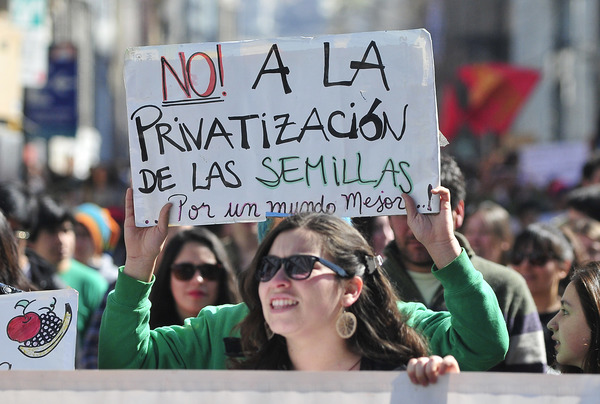
What could be more routine than saving seeds from one season to the next? After all, that is how we grow crops on our farms and in our gardens. Yet from Guatemala to Ghana, from Mozambique to Malaysia, this basic practice is being turned into a criminal offence, so that half a dozen large multinational corporations can turn seeds into private property and make money from them.
But people are fighting back and in several countries popular mobilisations are already forcing governments to put seed privatisation plans on hold.
GRAIN has produced an updated dataset
on how so-called free trade agreements are privatising seeds across the world.
Guatemala’s trade agreement with the US obliges it to adhere to the UPOV Convention. But popular resistance forced the government to repeal a national law passed for this purpose. (Photo: Raúl Zamora)

Trade agreements have become a tool of choice for governments, working with corporate lobbies, to push new rules to restrict farmers' rights to work with seeds. Until some years ago, the most important of these was the World Trade Organization's (WTO) agreement on Trade-Related Aspects of Intellectual Property Rights (TRIPS). Adopted in 1994, TRIPS was, and still is, the first international treaty to establish global standards for “intellectual property” rights over seeds.1The goal is to ensure that companies like Monsanto or Syngenta, which spend money on plant breeding and genetic engineering, can control what happens to the seeds they produce by preventing farmers from re-using them – in much the same way as Hollywood or Microsoft try to stop people from copying and sharing films or software by putting legal and technological locks on them.

Etiquetas: , ,

domingo, octubre 20, 2013

The Seed Map Project

http://seedmap.org/

Seedmap.org

Although, we rarely think about seeds, 9 out of every 10 bites of food we eat today start with seeds . And they are under incredible threat. Our planet has lost 75% of its plant genetic diversity between 1900 and 2000 , and 75% of our food is derived from only 12 plant and 5 animal species . The implications of this alarming biodiversity loss are serious and far-reaching, not only for food and nutrition security, but also for climate change adaptation, livelihoods and human survival. We need to act now to save biodiversity – nature’s brilliant insurance policy against disaster. That’s why we created seedmap.org

SEEDMAP.ORG: AN ONLINE PORTAL ON SEEDS, BIODIVERSITY AND FOOD

Interactive Seed Map PictureComplete with news, resources, campaigns and an interactive online seed map, Seedmap.org is a valuable teaching & advocacy tool and reference point on seeds, biodiversity, and food.
The heart of Seedmap.org is an interactive map that lets you visit hundreds of case studies around the world where agricultural biodiversity originated, is threatened, and where people are working to safeguard it. Read more…
To download a printable poster of the 2013 Seed Map exploring where our food comes from (4 MB), click here (can be printed on paper up to 11 x 17).

ABOUT THE SEED MAP PROJECT

2007 Printed Seed MapIn 2007, the update of a 1992 teaching kit evolved into a collaboration between USC Canada and ETC Group to create the hard copy wall-sized Seed Map. The Seed Map: Food, Farmers and Climate Chaos, chronicled the planet’s plant genetic wealth, how it is threatened, what are the solutions – all laid out in a physical map. It was a runaway success. More than 15,000 copies have travelled the world, in 7 languages.
We created Seedmap.org to replace the physical Seed Map and make it even more complete, up-to-date and interactive. Read more…
To download a printable poster of the 2013 Seed Map exploring where our food comes from (4 MB), click here (can be printed on paper up to 11 x 17).

Etiquetas: ,

jueves, agosto 22, 2013

Our seed, our sovereignty - seed law victory in Indonesia

TO READ THE FULL ARTICLE:
http://www.grain.org/bulletin_board/entries/4774-our-seed-our-sovereignty-seed-law-victory-in-indonesia

 
We don’t want to live as second class citizens anymore. We have always been discriminated against, but we are legal citizens of this country.
 
We had to breed our local seeds in hiding, since if government knew about this we wouldn't get any support from government.
 
This victory at the constitutional court gives us back our Dignity. Recognition and openness to continue our creativity is the dignity for farmers and breeders.
 
- Joharipin, a breeder from Indramayu , Kertasemaya, Indonesia)
 

Between 2005 and 2010, more than a dozen farmers from Kediri and Nganjuk regencies in East Java were prosecuted after seed companies accused them of stealing seed. But a judicial review by Indonesia's constitutional court has found several key articles of the legislation used to go after the farmers are unconstitutional.

Etiquetas: , , ,

miércoles, junio 26, 2013

VIDEO- Seeds of Freedom


http://seedsoffreedom.info/

The story of seed has become one of loss, control, dependence and debt. It’s been written by those who want to make vast profit from our food system, no matter what the true cost.  It’s time to change the story.


A landmark film from The Gaia Foundation and the African Biodiversity Network.

Narrated by Jeremy Irons.

Seeds of Freedom charts the story of seed from its roots at the heart of traditional, diversity rich farming systems across the world, to being transformed into a powerful commodity, used to monopolise the global food system.The film highlights the extent to which the industrial agricultural system, and genetically modified (GM) seeds in particular, has impacted on the enormous agro -biodiversity evolved by farmers and communities around the world, since the beginning of agriculture.

Seeds of Freedom seeks to challenge the mantra that large-scale, industrial agriculture is the only means by which we can feed the world, promoted by the pro-GM lobby. In tracking the story of seed it becomes clear how corporate agenda has driven the take over of seed in order to make vast profit and control of the food global system.

Through interviews with leading international experts such as Dr Vandana Shiva and  Henk Hobbelink, and through the voices of a number of African farmers, the film highlights how the loss of indigenous seed goes hand in hand with loss of biodiversity and related knowledge; the loss of cultural traditions and practices; the loss of livelihoods; and the loss of food sovereignty.  The pressure is growing to replace the diverse, nutritional, locally adapted and resilient seed crops which have been bred by small-scale farmers for millenia, by monocultures of GM seed.

Alongside speakers from indigenous farming communities, the film features global experts and activists Dr Vandana Shiva of Navdanya, Henk Hobbelink of GRAIN, Zac Goldsmith MP (UK Conservative party), Canadian farmer Percy Schmeiser, Kumi Naidoo of Greenpeace International, Gathuru Mburu of the African Biodiversity Network, Liz Hosken of The Gaia Foundation and Caroline Lucas MP (UK Green party).
This film is co-produced by  The Gaia Foundation and the African Biodiversity Network. In collaboration with GRAIN, Navdanya International and MELCA Ethiopia .


Etiquetas: , , , ,

martes, mayo 28, 2013

Eric Holt-Giménez on industrial seeds

viernes, marzo 15, 2013

New Report Exposes Devastating Impact of Monsanto Practices on U.S. Farmers


http://www.centerforfoodsafety.org/2013/02/12/cfs-save-our-seeds-release-new-report-seed-giants-vs-u-s-farmers/


WASHINGTON, D.C. –  – 
Center for Food Safety and Save Our Seeds Investigate Role of Seed Patents in Consolidating Corporate Control of Global Food Supply
Today, one week before the Supreme Court hears arguments in Bowman v. Monsanto Co., the Center for Food Safety (CFS) and Save our Seeds (SOS) – two legal and policy organizations dedicated to promoting safe, sustainable food and farming systems – will launch their new report, Seed Giants vs. U.S. Farmers.
The new report investigates how the current seed patent regime has led to a radical shift to consolidation and control of global seed supply and how these patents have abetted corporations, such as Monsanto, to sue U.S. farmers for alleged seed patent infringement.
Seed Giants vs. U.S. Farmers also examines broader socio-economic consequences of the present patent system including links to loss of seed innovation, rising seed prices, reduction of independent scientific inquiry, and environmental issues.
Debbie Barker, Program Director for Save Our Seeds and Senior Writer for the Report, said today:  “Corporations did not create seeds and many are challenging the existing patent system that allows private companies to assert ownership over a resource that is vital to survival, and that, historically, has been in the public domain.”
Among the report’s discoveries are several alarming statistics:
  • As of January 2013, Monsanto, alleging seed patent infringement, had filed 144 lawsuits involving 410 farmers and 56 small farm businesses in at least 27 different states.
  • Today, three corporations control 53 percent of the global commercial seed market.
  • Seed consolidation has led to market control resulting in dramatic increases in the price of seeds. From 1995-2011, the average cost to plant one acre of soybeans has risen 325 percent; for cotton prices spiked 516 percent and corn seed prices are up by 259 percent.
The report also disputes seed industry claims that present seed patent rules are necessary for seed innovation.  As Bill Freese, senior scientist at Center for Food Safety and one of the report’s contributors notes:  “Most major new crop varieties developed throughout the 20th century owe their origin to publicly funded agricultural research and breeding.”
Additionally, Seed Giants vs. U.S. Farmers reports a precipitous drop in seed diversity that has been cultivated for millennia. As the report notes:  86% of corn, 88% of cotton, and 93% of soybeans farmed in the U.S. are now genetically-engineered (GE) varieties, making the option of farming non-GE crops increasingly difficult.
While agrichemical corporations also claim that their patented seeds are leading to environmental improvements, the report notes that upward of 26 percent more chemicals per acre were used on GE crops than on non-GE crops, according to USDA data.
Further, in response to an epidemic of weed resistance to glyphosate, the primary herbicide used on GE crops, Dow AgroSciences is seeking USDA approval of “next generation” corn and soybeans resistant to 2,4-D, an active ingredient in Agent Orange.  Monsanto is seeking approval for GE dicamba-resistant soybeans, corn, and cotton.
At the launch of the report via teleconference today, experts from the Center for Food Safety and Save our Seeds were joined by Mr. Vernon Hugh Bowman, the 75-year-old Indiana soybean farmer who, next week, will come up against Monsanto in the Supreme Court Case.  When asked about the numerous comparisons being drawn between his case and the story of David and Goliath, Mr. Bowman responded, “I really don’t consider it as David and Goliath. I don’t think of it in those terms. I think of it in terms of right and wrong.”
In December of 2012, the Center for Food Safety, and Save Our Seeds submitted an amicus brief to the Supreme Court on behalf of Mr. Bowman, which supports the right of farmers to re-plant saved seed. Arguments in the case are scheduled for February 19th.
More information on the CFS and SOS can be found at: http://www.centerforfoodsafety.org

Etiquetas: , , ,

viernes, octubre 19, 2012

Open Sesame, a film about the history of seed


Seeds are the foundation of our food supply. They are as critically important as the air we breathe, or the water we drink but given much less attention. Unfortunately seeds face serious dangers that undermine the safety and long-term viability of our entire food system. 'Open Sesame - The Story of Seeds' looks at the challenges and opportunities facing our seed supply while inspiring viewers with the beauty and mystery inherent in seeds.

Please support the film makers on Kickstarter www.thestoryofseedsmovie.com

Etiquetas: , , , , ,

viernes, septiembre 21, 2012

Seed Freedom Fortnight


Seed Freedom Fortnight


 FORTNIGHT OF ACTIONS FOR SEED FREEDOM Oct 2nd – Oct 16th 2012
From 2nd October (Gandhi’s Birth Anniversary), to 16th October (World Food Day) the Global Alliance for Seed Freedom is planning intensive actions to create a global citizens’ response on the issue of Seed Freedom that we hope will act as a wake up call for citizens and the government. Gandhi had said, “as long as the superstition that unjust laws must be obeyed exist, so will slavery exist”. Humanity and diverse species on the Earth are being pushed into a new form of seed slavery. In the spirit of Gandhi, we therefore call for a civil disobedience against unjust laws. Below, we outline a number of ideas for actions that we emphasize are only a starting point. We look forward to planning common strategies and actions together as the campaign for Seed Freedom becomes stronger and louder.


Etiquetas: , , ,

martes, septiembre 11, 2012

Heirloom seed extravaganza

From the Organic Consumers Association's newsletter:

Join Ronnie Cummins and Leading Organic Activists at the National Heirloom Seed Exposition: September 11-13, in Santa Rosa, California

The National Heirloom Exposition is a national conference and exhibition focusing on organic food and farming, heirloom vegetables, and anti-GMO activism. The first annual event, held September 2011, in Santa Rosa, California, drew more than 10,000 people from around the country and beyond. With  more than 70 speakers and 250 natural food vendors, this year's event will be the largest gathering in pure food history!
The Heirloom Expo has gained incredible interest among home growers, farmers, school  groups and the general public - it's heralded as the “World’s Fair” of heirloom seeds.  This year, join OCA Director Ronnie Cummins, along with Carlo Petrini, Jeffrey Smith, Percy Schmeiser and more at the 2012  National Heirloom Expo!

Etiquetas: , , , ,

viernes, septiembre 07, 2012

Vandana Shiva: Act for seed freedom

martes, abril 13, 2010

Etiquetas: , ,

miércoles, junio 17, 2009

Seed Industry Structure

Consolidation has increased in the international seed industry in recent decades. The chart below depicts changes in ownership involving major seed companies and their subsidiaries, primarily occurring from 1996 to 2008.
1 The largest firms are represented as circles, with size proportional to global commercial seed market share.2


PDF version of Seed Industry Structure, 1996 - 2008

NOTE: The PDF version allows you to zoom in so you can see the small text.

SOURCE: https://www.msu.edu/~howardp/seedindustry.html

Etiquetas:

viernes, mayo 01, 2009

Who do baby food, beer and trees belong to?

New report shows dramatic scale on which patents are currently being granted

Lucerne/Munich, 24 April. - The European Patent Office is despite growing protests granting further property rights on foodstuffs, plants and seed which have been conventionally grown. This emerges from a report being presented today in Lucerne in Switzerland by Greenpeace, No Patents on Life, the Berne Declaration, Swissaid, the Development Fund and Misereor. Besides maize and lettuce, trees, baby food and beer are claimed in the 500 patent applications researched by the No Patents on Life organisation and in roughly 70 patents already issued. The organisations involved are calling for the flood of patents to be stopped by clear political guidelines. Only last week Greenpeace and Misereor filed an opposition to the breeding of pigs at the EPO.


"Some agricultural corporations want global monopolies on human food," says Christoph Then, a consultant to Greenpeace and one of the authors of the report. "In this way just ten corporations now control two-thirds of the global seed market. These patents are theft of what farmers' achievements in breeding. We need clear legal regulations prohibiting patents on seed and farm animals."


The report, The future of seeds and food under the growing threat of patents and market con­cen­t­ration, gives a comprehensive overview of the scale of the patenting of seed, plants and food in Europe. While patent applications for genetically modified plants have been on the decrease in the last few years, applications for plants that are conventionally grown are now booming. Should this practice be supported in an imminent decision by the EPO's Enlarged Board of Appeal, it is to be expected that farmers will be hugely impeded in their work in breeding in the future and will become more heavily dependent.


"Such patents make food more expensive and can be a new cause of global food crises," says Tina Goethe at Swissaid. "They affect farmers and consumers in the industrialised world just as much as people in developing countries."


The organisations have founded a global alliance, to which over 50 agricultural associations belong (http://www.no-patents-on-seeds.org/), to see their demands met. In the political arena, too, a reform of patent laws is on the agenda again. The state governments of Hesse and Bavaria have already declared they want to support a ban on the patenting of plants and animals.


The report in English or German can be downloaded from here.

Etiquetas: ,

domingo, octubre 12, 2008

http://www.grain.org/seedling/?id=564


Seed aid, agribusiness and the food crisis

GRAIN

The world food crisis, rapidly defined by those in power as a problem of insufficient production, has become a trojan horse to get corporate seeds, fertilisers and, surreptitiously, market systems into poor countries. As past experience shows, what looks like “seed aid” in the short term can mask what is actually “agribusiness aid” in the long term. We look at what is going on.

Earlier this year, political and economic leaders, abetted by the corporate mass media, were quick to explain the current global food crisis as a “perfect storm” of several factors: weather problems, the diversion of crops into biofuels, oil price hikes and poor people becoming less poor and eating more animal produce. In short, they wanted us to believe that the food crisis was a problem of production. Many have shredded that argument and – while agreeing that production should be improved – have shown instead how current economic policies focused on global trade and deregulation are the real culprits. [1] Yet the supply-siders moved fast to promote their solution to the wrong problem: to boost production, mainly by getting higher-yielding seeds to farmers.

What seeds? Where from? With what impact on vulnerable communities and local biodiversity? It is hard to find reliable data, but there is a serious risk that this simplistic production-focused response to the food crisis, which avoids asking the really challenging policy questions, will result in a new wave of genetic erosion and livelihood insecurity by overriding communities’ local seed systems. The consequences for the survival of farming families around the world, and therefore for food production, could be extremely damaging.

The “perfect choir”

Large amounts of money have been pledged in the last few months to send seeds and fertilisers urgently to food-crisis-striken countries in the South. In May, the World Bank launched a US$1.2-billion emergency finance facility to provide funds for the “rapid provision of seeds and fertilisers to small farmers”. Addressing the Group of Eight (G8) summit of the world’s richest countries, held in Japan in early July, the president of the World Bank, Robert Zoellick, told these powerful people that one of the main priorities in fighting the global food crisis was “to give small farmers, especially in Africa, access to seeds, fertilisers and other basic inputs”. In the lead-up to that meeting, the European Commission’s President, José Manuel Barroso, proffered €1 billion to pay for “fertilisers and seeds to help poor farmers in developing countries”. Not to be outdone, US President George Bush announced US$1 billion in food crisis money and told the press that he would convince other world leaders that they should make moves to alleviate hunger by “increasing the shipments of food, fertilisers and seeds to countries in need”. Two weeks later, the United Nations Secretary General, Ban Ki-Moon, took the message to the UN General Assembly in New York: “We must act immediately to boost agricultural production this year. We do this by providing urgently needed seeds and fertilisers for the upcoming planting cycles, especially for the world’s 450 million small-scale farmers.” [2] Imagine! Billions of dollars suddenly disbursed to distribute seeds to the poorest farmers on the planet – a group whose needs have never before ranked high in these leaders’ concerns.

Earlier the UN’s Food and Agriculture Organisation (FAO) had launched its own “Initiative on Soaring Food Prices”, meant to “demonstrate that by increasing the supply of key agricultural inputs, such as seeds and fertilisers, small farmers will be able to rapidly increase their food production”. The FAO Initiative already covers 35 countries, to the tune of US$21 million, while another 54 countries are being similarly supported under its Technical Cooperation Programme at the cost of US$24 million. Apart from ensuring immediate seed and fertiliser supplies, the Initiative also aims to “encourage donors, financial institutions and national governments to support the provision of inputs on a much larger scale”. [3] It seems to be working, as organisations ranging from the Bill & Melinda Gates Foundation to the Red Cross are falling over each other to set up programmes to get seeds and fertilisers to farmers in response to today’s food crisis (see table).

Etiquetas: , , ,

martes, junio 03, 2008

viernes, marzo 07, 2008

Semillas


Navdanya significa «nuevas semillas» , un nombre que evoca la riqueza de la diversidad y el deber de defenderla frente a la invasión de las biotecnologías y de los monocultivos de la agricultura industrial. Junto con las patentes que monopolizan los derechos de propiedad intelectual introducidos por la omc, por el Convenio de Diversidad Biológica y por otros acuerdos comerciales, las biotecnologías reducen la diversidad de las formas de vida al papel de materia prima para la industria y los beneficios. Las semillas genéticamente modificadas encierran a los pequeños agricultores en una jaula de deudas y mentiras. Por eso las llamo las “semillas del suicidio”. Se las hace estériles, a fin de que no puedan reproducirse y tengan que ser adquiridas cada año por los campesinos a precios elevados. Las patentes de las semillas son propiedad de transnacionales como Monsanto, que de esta forma se apropian de las fuentes de vida y de los derechos de dos terceras partes de la humanidad.

La desobediencia civil implica la opción por la no-violencia y por la no-cooperación pacífica. Yo creo que también hoy ésta es la vía a seguir, comenzando por la resistencia al patentamiento de las semillas. En India está en discusión una ley que podría traer consigo la prohibición del uso de semillas propias por parte de los campesinos. Semillas que durante miles de años han sido conservadas y transmitidas de generación en generación y de cosecha en cosecha, quedarían así desplazadas para dar lugar a la comercialización de semillas carísimas producidas en los laboratorios de las transnacionales. Nosotros sabemos que la variedad de las semillas indígenas, conservadas y seleccionadas localmente, representa nuestra garantía ecológica y económica, porque esas semillas diversas están en condiciones de adaptarse perfectamente a las condiciones climáticas y geológicas de las diversas regiones de India. No se puede criminalizar a centenares de millones de campesinos que no están dispuestos a someterse al modelo agrícola impuesto por las transnacionales. Para conquistar nuestra libertad económica y política es necesario volver a otra vez la mirada a Gandhi, a sus ideas de autogobierno y de autoproducción local.

- Vandana Shiva, entrevistada por Tommaso Rondinella y Duccio Zola,
Il Manifesto, 10 de octubre de 2006


women in field

La solución propuesta por agra (Alliance for a Green Revolution in Africa), la alianza para llevar una Revolución Verde a África, es construir la infraestructura que facilite el desarrollo de compañías semilleras privadas, algo que la Fundación Rockefeller y el Banco Mundial han intentado por algún tiempo ya, pero con poco éxito. Uno de los primeros pasos de agra entonces sería el establecimiento de redes de “agrointermediarios” (“agrodealers”). que vendan semillas, pesticidas y fertilizantes. agra ya contrató a una ong estadounidense, Citizens’ Network for Foreign Affairs, para realizar este trabajo en Kenya, Tanzania y Malawi. Hasta ahora, la ong estadounidense ha recibido hasta 14 millones de dólares en donaciones… para abastecer a los intermediarios, los donantes de agra también financian a las compañías semilleras privadas. La Fundación Rockefeller es el principal inversionista en African Agricultural Capital, un proyecto con capital de riesgo que invierte en pequeñas compañías semilleras africanas y en parte las controla, compañías que a su vez reciben financiamiento de agra. Con toda seguridad intentan desarrollar mercados entre los campesinos, mercados que siguen siendo muy limitados por la empecinada resiliencia de los sistemas tradicionales de semillas que siempre han abastecido a los campesinos africanos con semillas de alta calidad, adaptada localmente, culturalmente aceptada y muy costeable.


- A new green revolution for Africa?, www.grain.org, diciembre de 2007

Etiquetas: , , ,

jueves, febrero 28, 2008


Faults in the vault: not everyone is celebrating Svalbard

GRAIN

After months of extraordinary publicity, and with the apparently unanimous support of the international scientific community, the "Global Seed Vault" was officially opened today on an island in Svalbard, Norway. Nestled inside a mountain, the Vault is basically a giant icebox able to hold 4.5 million seed samples in cold storage for humanity's future needs. The idea is that if some major disaster hits world agriculture, such as fallout from a nuclear war, countries could turn to the Vault to pull out seeds to restart food production. However, this "ultimate safety net" for the biodiversity that world farming depends on is sadly just the latest move in a wider strategy to make ex situ (off site) storage in seed banks the dominant – indeed, only – approach to crop diversity conservation. It gives a false sense of security in a world where the crop diversity present in the farmers' fields continues to be eroded and destroyed at an ever-increasing rate and contributes to the access problems that plague the international ex situ system.

Faulty assumptions

Cary Fowler, Director of the Global Crop Diversity Trust and one of the main proponents of the Vault, says that the initiative "will rescue the most globally important developing-country collections of the world’s 21 most important food crops." While it's true that crop diversity needs to be rescued and protected, as irreplaceable diversity is being lost at an alarming scale, relying solely on burying seeds in freezers is no answer. The world currently has 1,500 ex situ genebanks that are failing to save and preserve crop diversity. Thousands of accessions have died in storage, as many have been rendered useless for lack of basic information about the seeds, and countless others have lost their unique characteristics or have been genetically contaminated during periodic grow-outs. This has happened throughout the ex situ system, not just in genebanks of developing countries. So the issue is not about being for or against genebanks, it is about the sole reliance on one conservation strategy that, in itself, has a lot of inherent problems.

The deeper problem with the single focus on ex situ seed storage, that the Svalbard Vault reinforces, is that it is fundamentally unjust. It takes seeds of unique plant varieties away from the farmers and communities who originally created, selected, protected and shared those seeds and makes them inaccessible to them. The logic is that as people's traditional varieties get replaced by newer ones from research labs – seeds that are supposed to provide higher yields to feed a growing population – the old ones have to be put away as "raw material" for future plant breeding. This system forgets that farmers are the world's original, and ongoing, plant breeders. To access the seeds, you have to be integrated into a whole institutional framework that most farmers on the planet simply don't even know about. Put simply, the whole ex situ strategy caters to the needs of scientists, not farmers

In addition, the system operates under the assumption that once the farmers' seeds enter a storage facility, they belong to someone else and negotiating intellectual property and other rights over them is the business of governments and the seed industry itself. In the case of most so-called public genebanks, the seeds are said to become part of "the public domain" if not "national sovereignty" (which increasingly translates to state ownership). The Consultative Group on International Agricultural Research (CGIAR), which runs about 15 global genebanks for the world's most widely used staple food crops, has even set up a legal arrangement of "trusteeship" that it exercises over the treasure chest of farmers' seeds that it holds "on behalf of" the international community, under the auspices of the FAO. Yet they never asked the farmers whom they took the seeds from in the first place if this was okay and they left farmers totally out of the trusteeship equation.

The new Svalbard Vault lies squarely at the pinnacle of this faulty architecture and false assumptions, inevitably exacerbating these problems. Because it is a "doomsday" backup collection, it raises the stakes to new extremes. Nobody really knows for sure if the Vault will be effective in keeping the seeds alive and its security is untested. Just days before the opening of the Vault, Svalbard was at the centre of the biggest earthquake in Norway's history, even though the facility's feasibility study assured that "there is no volcanic or significant seismic activity" in the area. But more troubling than any technical matter is the issue of access, the keys to which are held by few hands.


READ THE REST: http://www.grain.org/articles/?id=36

Etiquetas: , ,